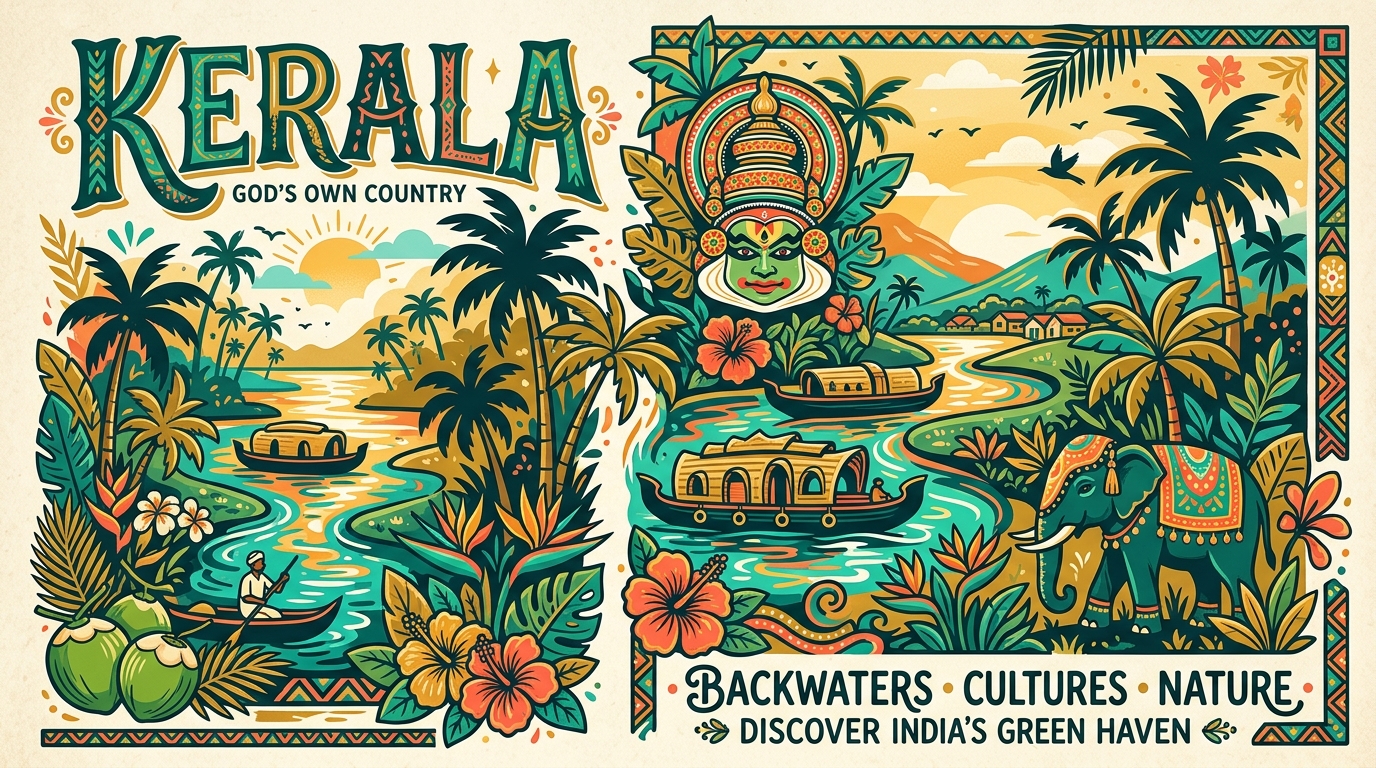
Kerala
“God's Own Country with backwaters and spices”
Overview & Heritage
Kerala • South India
Kerala occupies a slender strip of India's Malabar Coast, where the Western Ghats drop steeply to the Arabian Sea over a width of just 35 to 120 km. At only 38,863 km² — about 1.2% of India's area — and a projected 35.4 million people (2025 projection), it is India's most densely settled southern state at about 860 persons per km², yet also its most human-development advanced. Thiruvananthapuram on the southern tip is the capital, while Kochi is the commercial port and Kozhikode the historic spice-city in the north. Branded 'God's Own Country', Kerala is famous for a rare combination: 580 km of palm coastline backed by continuous backwaters, hills of tea at Munnar and cardamom, and social indicators that often lead India — the highest literacy rate (about 96%), the highest life expectancy and the highest female-to-male ratio. Wedged between the Ghats and the sea, it contains three stacked landscapes — highlands, midlands and lowlands — in less than 100 km, making it a compact case study for physical geography, ecology and development studies alike.
“A cornerstone of South India, Kerala embodies millennia of vibrant history, distinct geography, and legendary cultural traditions.”
History & Dynasties
Kerala's history was written by spice. As early as 3000 BCE, coastal Muziris near present-day Kodungallur served as a global port where Chera dynasty merchants traded black pepper — 'black gold' — with Phoenicians, Egyptians, Greeks and Romans; Roman gold coins and amphorae excavated at Pattanam confirm this two-way link that appears in Pliny's writings. Arab and Chinese traders followed, leaving mosques and synagogues along the coast, including the 16th-century Paradesi Synagogue at Mattancherry and India's oldest mosque at Kodungallur. European colonialism in Asia began here when Vasco da Gama landed at Kappad beach near Kozhikode on 20 May 1498, seeking direct spice access; the Portuguese, then the Dutch (who beat the Portuguese at Cochin in 1663) and finally the British shaped fortunes, while inland princely states Travancore and Cochin retained autonomy under enlightened Rajas like Marthanda Varma and Swathi Thirunal. Social reformers Sree Narayana Guru, Chattampi Swamikal and Ayyankali in the late 19th and early 20th centuries fought caste exclusion and pioneered universal education, laying groundwork for Kerala's later achievements. After Independence, on 1 November 1956 the Malayalam-speaking areas of Travancore-Cochin and Malabar district from Madras Presidency were merged to form Kerala under the States Reorganisation Act — celebrated annually as Kerala Piravi. In 1957 it made world headlines by electing the first democratically elected communist government in history.
Nature & Geography
Kerala divides neatly into three zones that students can sketch in cross-section. To the east are the cool highlands — the Western Ghats, older than the Himalayas — running continuously for about 450 km with Anamudi at 2,695 metres in Idukki as the highest peak in South India, surrounded by cardamom, tea and evergreen shola forests. The central midlands are rolling laterite hills with cashew, rubber and paddy, while the western lowlands are coastal alluvial plains laced with water. With 44 rivers — 41 west-flowing and three east-flowing — all monsoon-fed and rising in the Ghats, Kerala's hydrology is distinctive. Periyar (244 km) is the longest; others include Bharathappuzha, Pamba and Chaliyar. The same steep gradient creates the backwaters — a 900 km network of interconnected lakes, lagoons, canals and estuaries, the largest being Vembanad Lake (also called Vembanad Kayal), India's longest lake at 96.5 km and largest wetland system at about 2,033 km², spanning Alappuzha, Kottayam and Ernakulam and fed by six major rivers. Climate is tropical maritime: temperatures average 19.8°C to 36.7°C, but rainfall is extraordinary — about 3,000 mm annually on the coast and over 5,000 mm in the Ghats, with the southwest monsoon hitting Kerala first in India around 1 June each year. Protected areas include Periyar Tiger Reserve around Thekkady's artificial lake, Eravikulam National Park which shelters the endemic Nilgiri tahr, and Silent Valley National Park in Palakkad — one of India's last undisturbed evergreen tracts and part of the Nilgiri Biosphere Reserve. Much of the Western Ghats portion in Kerala is inscribed as UNESCO World Heritage (2012) for its 325 threatened species and exceptional endemism; it is one of the world's eight 'hottest hotspots' of biodiversity.
Culture & Arts
Malayalam, the official language and a Classical language of India, dominates, and Kerala's cultural forms are among the most physical in India. Kathakali, developed in the 17th century, is a classical dance-drama where male actors in towering headgear and heavy green face paint enact Mahabharata and Ramayana episodes through mudras (hand gestures) and eye movements; its gentler counterpart is Mohiniyattam, a solo women's dance, while Koodiyattam (UNESCO Intangible 2008) is the 2,000-year-old Sanskrit theatre still performed at temples in Thrissur. Martial art Kalaripayattu is often cited as one of the world's oldest, built on animal postures, and the snake-boat races — Vallam Kali — see 100-foot-long chundan vallams with up to 100 oarsmen racing on Punnamada Lake during Onam; the Nehru Trophy Boat Race there in August is a state carnival. Harvest festival Onam, the most widely celebrated, honours King Mahabali's annual return with pookalam flower carpets, Onapattu songs and the Onasadya: a payasam-ending feast of up to 26 dishes served on a banana leaf. Cuisine is coconut and curry-leaf fragrant: puttu with kadala curry, appam with ishtu, Malabar parotta, fish moilee, avial, and banana-chip topped sadya. Ayurveda thrives around Kottakal and Kovalam. Heritage markers include the spice-trade architecture of Fort Kochi, Muziris heritage revival, and the Padmanabhaswamy Temple at Thiruvananthapuram, whose vaults drew global attention.
Fun Facts
Kerala has India's highest literacy rate at about 96.2% (2018 NSO survey) and the highest Human Development Index among states at 0.782, driven by decades of universal education and healthcare — figures often highlighted in development studies.
Kalaripayattu from northern Kerala is considered one of the world's oldest surviving martial arts, dating in codified form to at least the 12th century, with practitioners mastering 18 unarmed and armed stages and the healing art of marmachikitsa (vital point therapy).
Vembanad Lake is India's longest lake at 96.5 km and largest lake by area at about 2,033 km², stretching across three districts; its Kuttanad southern basin at about 2.2 metres below sea level hosts India's only below-sea-level paddy farming (a Ramsar site).
Kerala's sex ratio at 1,084 females per 1,000 males (2011 Census, similar in projections) is the only state ratio above parity and among the highest globally, reflecting strong maternal health and girl education.
The Western Ghats, running 450 km along Kerala's east, was inscribed as a UNESCO World Heritage natural site in 2012; its Kerala sub-clusters — Agasthyamala, Periyar, Anamalai and Nilgiri — together contain at least 325 globally threatened species.
Kerala's backwater staple, the kettuvallam (houseboat), is built without a single nail — planks of anjali wood are tied with coir rope and sealed with cashew-nut oil and resin, a technique that keeps the hull flexible during monsoon swells.