Karnataka
“One state, many worlds — Silicon Valley of Asia”
Overview & Heritage
Karnataka • South India
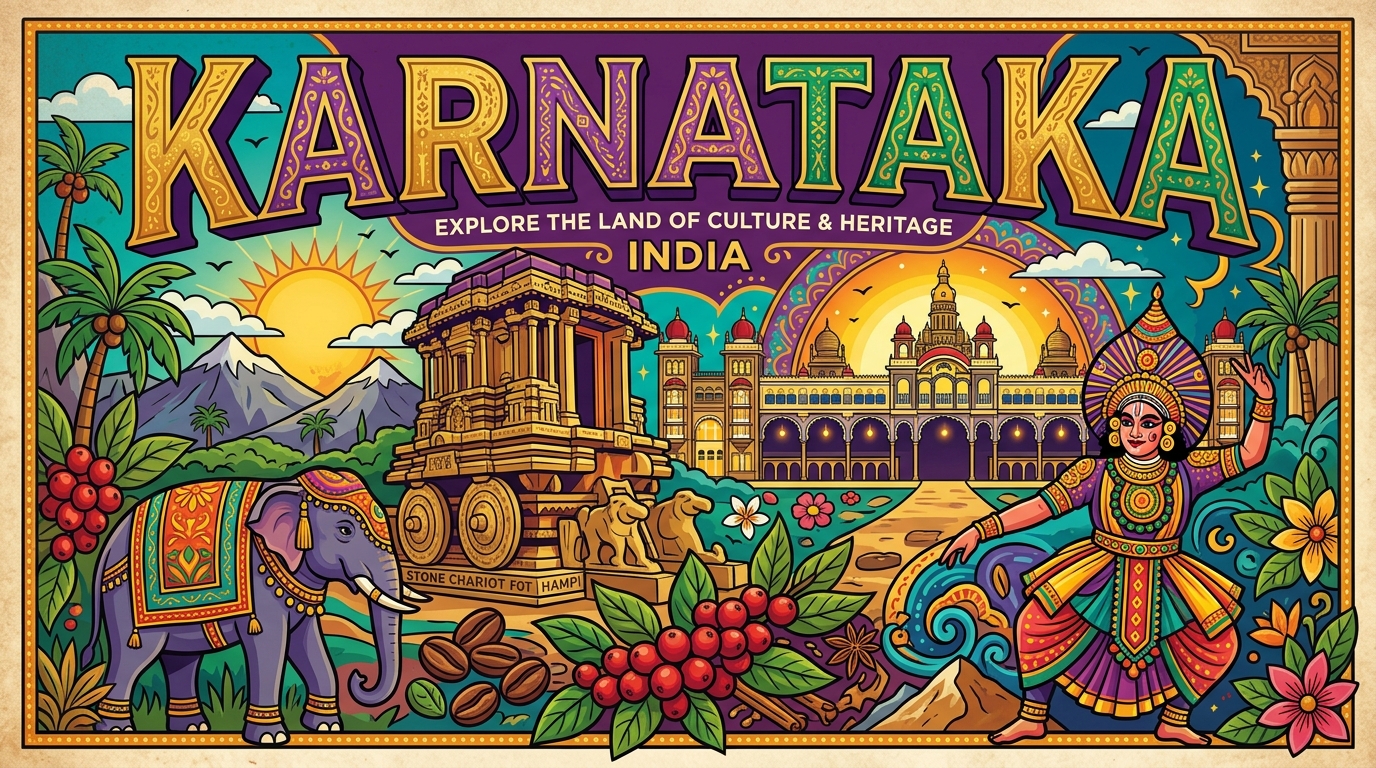
Karnataka sits in southwestern India where the Deccan Plateau meets the Arabian Sea, spanning 191,791 km² with a projected 67.6 million people (2025 projection) and sharing borders with six states — Goa, Maharashtra, Telangana, Andhra Pradesh, Tamil Nadu and Kerala — more than any other South Indian state. Bengaluru, the capital, anchors it as India's 'Silicon Valley', hosting Indian space (ISRO), biotech and startups, yet just a few hours away lie misty coffee hills, a 320 km palm-fringed Karavali coast, and the ruins of Hampi. If you need one image, hold both together: glass IT campuses in Whitefield and boulder-strewn Vijayanagara temples in the north. For students, Karnataka is essential because it compresses India's contrasts — ancient temple architecture, one of the world's biodiversity hotspots in the Western Ghats, and contemporary technology — within a single state. Kannada is the official language and a Classical language of India, spoken in a distinctive red-yellow flagged cultural zone that celebrates both Mysuru's royal heritage and Mangaluru's coastal trade.
“A cornerstone of South India, Karnataka embodies millennia of vibrant history, distinct geography, and legendary cultural traditions.”
History & Dynasties
Karnataka's history is a succession of temple-building empires that every Indian history textbook highlights. The Kadambas of Banavasi (4th century) were the first Kannada dynasty, followed by the Badami Chalukyas in the 6th century who built the UNESCO rock-cut temples at Pattadakal — a meeting of North and South Indian styles — and the Rashtrakutas of Manyakheta, whose emperor Krishna I carved the Kailasa temple at Ellora. By the 12th century the Hoysalas at Belur and Halebidu refined the star-shaped temples with lathe-turned pillars and friezes seen in the Chennakeshava temple, now part of the 2023 UNESCO inscription 'Sacred Ensembles of the Hoysalas'. The grandest chapter was the Vijayanagara Empire founded in 1336 by brothers Harihara and Bukka at Vijayanagara (modern Hampi) on the Tungabhadra, which at its peak under Krishnadevaraya (1509–1529) ruled much of South India and made Hampi, by some traveler accounts, the world's second-largest city around 1500 with perhaps 500,000 residents spread over 25 km², until its army was defeated by the Deccan Sultanates at Talikota in 1565. In the 18th century Mysuru rose under Hyder Ali and his son Tipu Sultan, the 'Tiger of Mysore', who fought four Anglo-Mysore wars before Tipu's death defending Srirangapatna in 1799. After British restoration of the Wadiyars, Mysore State joined India in 1947. Under the States Reorganisation Act on 1 November 1956 the Kannada-speaking areas of Bombay, Hyderabad and Madras were merged into Mysore State, which was formally renamed Karnataka on 1 November 1973 — a renaming often asked alongside the 1956 reorganization year.
Nature & Geography
Karnataka shows three clear physiographic belts. The narrow Karavali coast along the Arabian Sea is sandy and lateritic, broken by estuaries at Mangaluru, Karwar and Gokarna. Immediately east rise the Western Ghats (Sahyadri), a 1,600 km UNESCO World Heritage range that reaches 1,925 metres at Mullayyanagiri in Chikkamagaluru, Karnataka's highest peak. These evergreen forests are one of the world's eight 'hottest hotspots' of biodiversity and create a rain shadow — they receive over 3,000 mm of rainfall at Agumbe, among India's wettest places, while the eastern Malnad hills transition to the semi-arid Deccan Plateau drained by the Krishna, Tungabhadra, Cauvery and Sharavathi rivers. The contrast produces striking sites: Jog Falls on the Sharavathi, at 253 metres the second-highest plunge waterfall in India, where four cascades — Raja, Rani, Rover and Rocket — drop in monsoon force, and the marshlands of Ranganathittu near Mysuru. Forests cover about 20% of the state. Bandipur National Park and Nagarhole National Park (Rajiv Gandhi National Park), contiguous with Tamil Nadu's Mudumalai and Kerala's Wayanad, form the core of the Nilgiri Biosphere Reserve (UNESCO 1986) and together hold Asia's largest wild elephant population — more than 6,000 elephants counted — plus Bengal tigers, leopards, dholes and sloth bears. Nearby, Bannerghatta near Bengaluru, Kudremukh (famed for mining debate), and Dandeli-Anshi in the northwest protect lion-tailed macaques, great pied hornbills and the king cobra of Agumbe.
Culture & Arts
Kannada is the sole official language and one of India's oldest literary languages, with Halmidi inscriptions from the 5th century and Jnanpith awards among the highest for any language. Karnataka shaped Carnatic music through Purandara Dasa (1484–1564), regarded as its founding father, born in Karnataka. Theatre form Yakshagana, with elaborate costumes and all-night open-air shows along the coast, and the wooden puppetry of Kinnala preserve performance traditions. The state's signature festival is Mysuru Dasara, a ten-day royal celebration where the Wadiyar palace is lit with nearly 100,000 bulbs and a caparisoned elephant carries the goddess Chamundeshwari in procession — a tradition continuing since the 17th century Vijayanagara-era custom. Craft heritage is GI-rich: Mysore Silk sarees woven with gold zari, rosewood inlay of Mysuru, sandalwood carving, Bidri metalwork from Bidar where silver is inlaid into blackened alloy, and Channapatna wooden toys, lacquered on lathes and now protected as a GI craft from the 'toy town' near Bengaluru. Food reflects plateau and coast: ragi mudde (finger millet balls) with sambar in the south, Jolada roti of the north, bisi bele bath, Mysore masala dosa, and filter coffee from Chikkamagaluru — where Baba Budan first brought coffee beans from Yemen in the 17th century, planting them in the hills now named Baba Budangiri — with coastal Mangalorean fish curry and Neer dosa adding variety. UNESCO recognizes two sites in Karnataka: the Group of Monuments at Hampi (1986) and at Pattadakal (1987), while the Hoysala temples of Belur, Halebidu and Somanathapura were added in 2023.
Fun Facts
Bengaluru is called the 'Silicon Valley of India' and hosts over 40% of India's IT industry plus ISRO headquarters, Infosys and Wipro campuses — the city grew from about 400,000 people in 1950 to over 14 million today in the metropolitan area.
At its peak around 1500, Vijayanagara (Hampi) was described by Portuguese traveller Domingo Paes as a city as large as Rome with perhaps 500,000 residents, making it then the second-largest city globally after Beijing — its ruins cover 4,187 hectares at the UNESCO site.
Karnataka grows about 70% of India's coffee, with Chikkamagaluru (where Baba Budan first planted beans in 1670), Kodagu (Coorg) and Hassan forming the core belt of Arabica and Robusta grown under shade, as per the Coffee Board of India.
The monolithic statue of Bahubali (Gommateshwara) at Shravanabelagola, carved from a single granite block in 981 CE, stands 57 feet (17.7 metres) tall and can be seen from 25 km away; the Mahamastakabhisheka anointing festival is held every 12 years.
Mysore Paints and Varnish Ltd. in Mysuru, Karnataka, is India's sole authorized manufacturer of indelible election ink (with silver nitrate) used in every Lok Sabha and Assembly election since 1962; a finger mark can last up to 10 days.
Jog Falls on the Sharavathi River drops 253 metres (830 feet) in four distinct cascades, making it India's second-highest plunge waterfall and a classic case study of Western Ghats river capture.