
Jammu and Kashmir
“Paradise on Earth with serene valleys and lakes”
Overview & Heritage
Jammu and Kashmir • Union Territory India
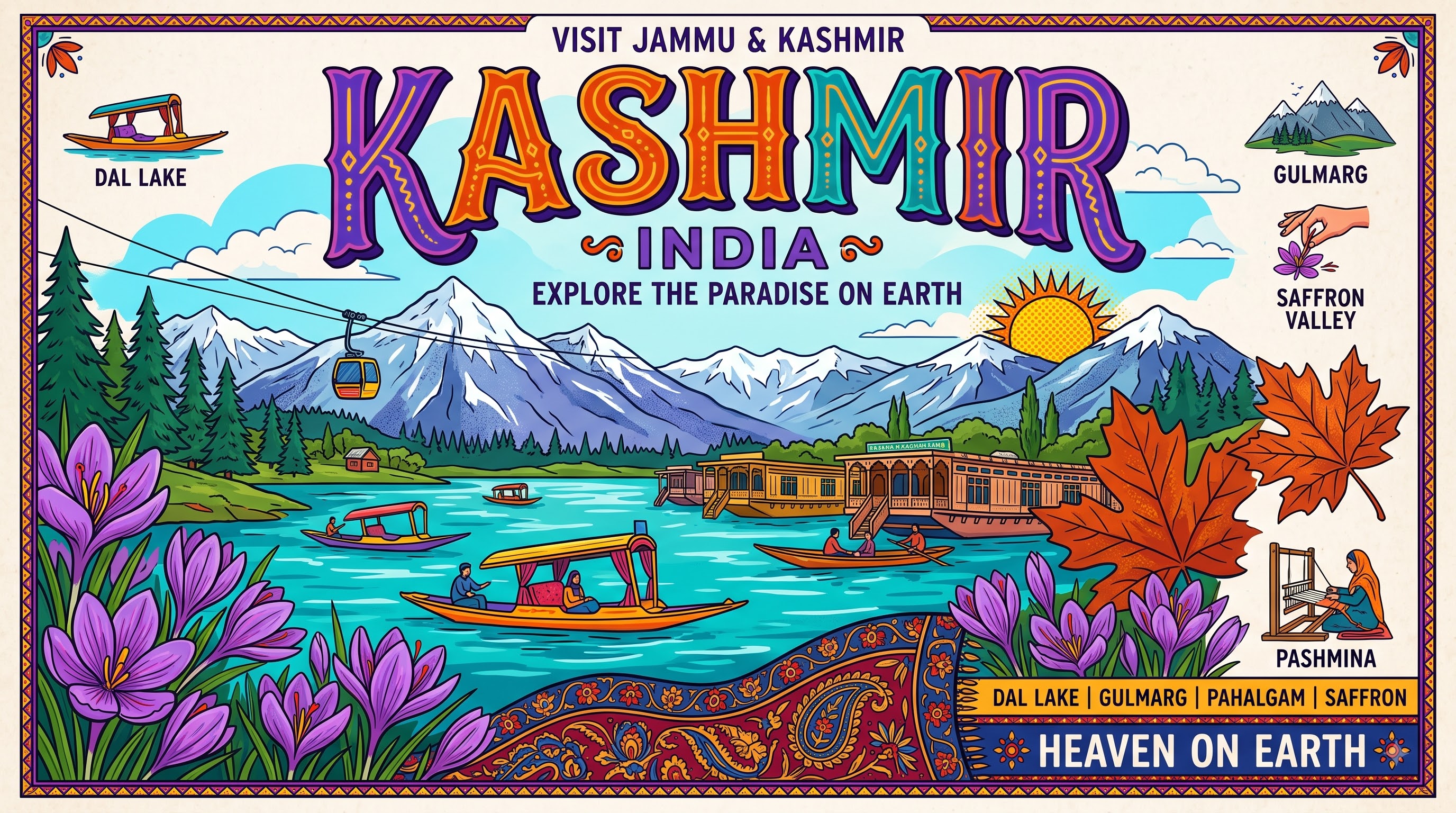
Jammu and Kashmir occupies 42,241 km² between the Pir Panjal and the Great Himalayas in India's far north, comprising the two divisions of Jammu to the south and the Kashmir Valley to the north. If you hold one picture, hold this: houseboats moored on Dal Lake at dawn, Chinar leaves turning copper, and saffron fields purple against snow on the Zabarwan hills beyond. As per Ministry of Home Affairs figures, the Union Territory covers 42,241 km² with 20 districts and a projected population of about 13.6 million in 2025 — the 2011 Census counted 12.27 million and Technical Group projections place 2025–26 around 13.7–13.9 million. Srinagar (on the Jhelum) acts as summer capital and largest city, while Jammu (on the Tawi) serves as winter capital, a seasonal shift inherited from princely practice. Bordered by Ladakh, Himachal Pradesh and Punjab, and the Line of Control, the territory is dual in character: the temperate Valley famed as “Paradise on Earth” and the warmer, temple-studded Jammu plains.
“A cornerstone of Union Territory India, Jammu and Kashmir embodies millennia of vibrant history, distinct geography, and legendary cultural traditions.”
History & Dynasties
Kashmir's written history is unusually continuous. Kalhana's 12th-century Rajatarangini traces kings from antiquity through the Karkota and Utpala dynasties, when Sanskrit scholarship and Shaiva philosophy flourished and Buddhism remained influential around Harwan. After the 14th-century establishment of the Shah Miri sultanate — with Rinchana as an early convert and later Zain-ul-Abidin known for tolerant rule — the Valley came under the Mughals under Akbar in 1586, who called it his garden, then Afghans and Sikhs after 1819 when Maharaja Ranjit Singh annexed it.
Modern political history begins with the Treaty of Amritsar on 16 March 1846. After the First Anglo-Sikh War, the British transferred hilly country between the Indus and the Ravi to Raja Gulab Singh of Jammu for 7.5 million Nanakshahi rupees, creating the princely state of Jammu and Kashmir under the Dogra dynasty until 1947.
In October 1947, after tribal raiders entered the Valley, Maharaja Hari Singh signed the Instrument of Accession to India on 26 October 1947, accepted on 27 October. Article 370 granted special status until 2019, when Parliament passed the Jammu and Kashmir Reorganisation Act — effective 31 October 2019 — bifurcating the former state into two Union Territories: Jammu and Kashmir (with legislature) and Ladakh (without legislature), now administered by a Lieutenant Governor.
Nature & Geography
Jammu and Kashmir's landscape is a northward staircase. The outer Shivaliks around Jammu (300–600 metres) are subtropical with chir pine; the Pir Panjal rises to about 3,500–4,000 metres and separates Jammu from the Valley; the Valley itself is a former karewa lake bed at about 1,600 metres, drained by the Jhelum; beyond, the Great Himalayas culminate at Nun Kun at 7,135 metres on the Ladakh border. Rivers define its lifelines: the Chenab carving gorges in Jammu, the Jhelum meandering within the Valley, and the Tawi through Jammu city. Climate is temperate continental: Jammu summers reach 40–44°C while Srinagar summers are mild at 25–30°C; winter brings regular snowfall, with Srinagar averaging several snow days and higher meadows like Gulmarg receiving metres of snow.
Horticulture thrives on karewa soils — apples around Sopore and Shopian, walnuts, cherries and saffron at Pampore, one of very few places worldwide to produce high-grade saffron. Forests cover about 23% of the territory, with deodar, fir and Chinar (Platanus orientalis) planted by Mughals.
Protected areas include Dachigam National Park (141 km²) above Srinagar for the critically endangered hangul (Kashmir stag), Kishtwar National Park on the Chenab, and Overa-Aru and Hirpora sanctuaries that host black bear and markhor. Alpine meadows (margs) such as Gulmarg and Sonamarg serve as summer pastures and skiing bases.
Culture & Arts
Culture in J&K is layered — Kashmiri, Dogra, Gujjar–Bakarwal and Tibetan-Buddhist influences meeting along the Pir Panjal. Language policy reflects this mosaic: as per the Jammu and Kashmir Official Languages Act, 2020, Kashmiri, Dogri, Urdu, Hindi and English are official for Union Territory purposes, with Urdu long serving as lingua franca and medium of record and Kashmiri spoken by about 53% of the population in the Valley as per Census 2011, Dogri by about 20% around Jammu. At street level, shop signs, school primers and assembly debates now cycle through these five.
Crafts are world-renowned and GI-tagged. Kashmiri shawl weaving — Pashmina from the undercoat of Changthangi goats wintering on the Tibetan plateau and Shahtoosh historically, now banned — involves hand-spinning and months of work per shawl; Kani weaving, Crewel embroidery, papier-mâché, walnut wood carving, carpet (Kaleen) knotting and copperware sustain artisan clusters in Srinagar's old city. Cuisine centres on the elaborate Wazwan feast of the Valley — a ceremonial 36-course meal developed for royalty, featuring seekh kababs, tabak maaz, rogan josh, yakhni and gustaba — prepared by master chefs (wazas) and eaten together on tramis; Jammu offers Dogra dishes like rajma-chawal, anardana chutney and Auriya. Music includes Sufiana Kalam and Dogri folk Geet; the floating vegetable market on Dal Lake at dawn, where Shikara boats trade tomatoes and lotus stems, and the houseboat tradition itself, capture an amphibious way of life shaped by lakes and rivers.
Fun Facts
The Chenab Rail Bridge between Bakkal and Kauri in Reasi district stands 359 metres above the riverbed — the world's highest railway arch bridge, 35 metres taller than the Eiffel Tower, and a key link in the 272 km Udhampur–Srinagar–Baramulla Rail Link inaugurated in stages through 2024–25.
Dal Lake in Srinagar hosts India's only floating post office, operating from a traditional houseboat and using a unique seal with a shikara motif; during winter, parts of the lake can skin-freeze, allowing brief ice skating.
Pampore, about 13 km from Srinagar on the Jhelum's karewas, produces high-grade Kashmiri saffron (Crocus sativus), among the world's few authentic saffron terroirs alongside Iran and Spain, with about 3,000 hectares under cultivation as per state agriculture data.
The Gulmarg Gondola rises to about 3,980 metres at its upper station near Apharwat Peak, one of the highest operating cable cars in the world and a core asset for skiing, with a vertical gain of about 1,330 metres from Gulmarg resort.
Dachigam National Park was demarcated in 1910 to secure Srinagar's drinking water catchment and now protects the hangul, the critically endangered Kashmir stag endemic to the Valley, whose census has fluctuated to only about 250 individuals in recent surveys (flag: exact counts vary annually).
The traditional Chunth or Chinar tree (Platanus orientalis) — called Bouen in Kashmiri — was popularly introduced to the Valley by the Mughals and Sufis; a tree at Chinar Bagh on the Jhelum is estimated by some local accounts to be about 600–700 years old (flag: precise dating is local tradition rather than dendrochronologically verified).