
Haryana
“Land of the Bhagavad Gita and sports champions”
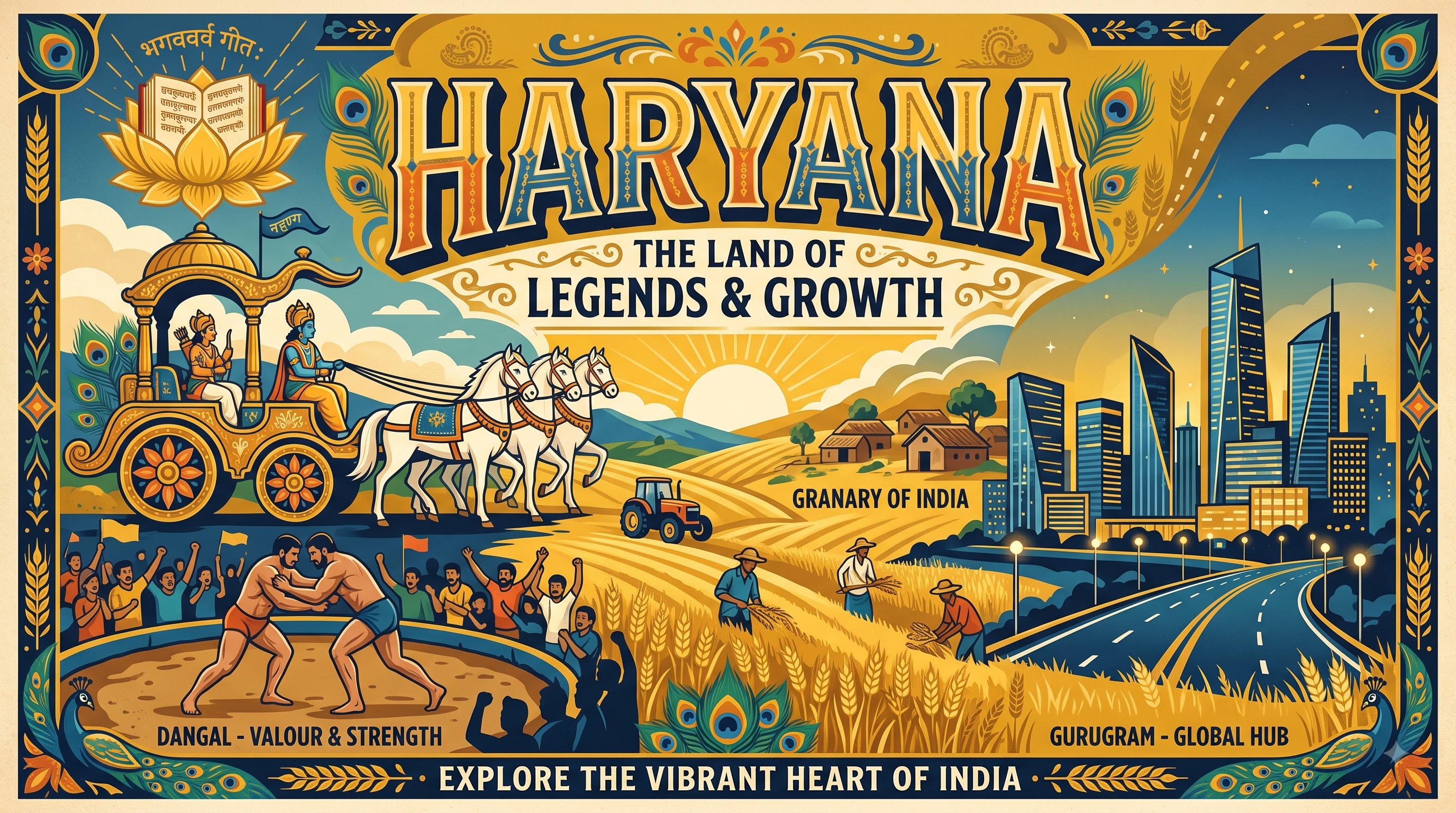
Overview & Heritage
Haryana • North India
Haryana wraps around the national capital of Delhi on three sides, occupying 44,212 km² on the fertile edge of the Indo-Gangetic plain. If you remember one image, remember this: mustard-yellow fields and wheat stubble giving way, within an hour, to the glass towers of Gurugram and the wide boulevards of shared capital Chandigarh. Bordered by Punjab and Himachal Pradesh to the north, Rajasthan to the west and south, and the Yamuna River marking its eastern boundary with Uttar Pradesh, Haryana is compact — ranking 20th by area — yet disproportionately influential. With a projected population of about 30.2 million in 2025 (as per the Technical Group on Population Projections, with alternative estimates near 31.4 million for 2026), density exceeds 650 people per km². The state is best understood as two economies intertwined: an agrarian base that helped drive India's Green Revolution in the 1960s and 1970s, producing wheat, rice, bajra and sugarcane, and a modern industrial corridor centred on Gurugram and Faridabad for automobiles, IT, textiles and logistics. It is also the most obvious gateway state for students of modern India, linking ancient Kurukshetra, Harappan Rakhigarhi, and the battlefields of Panipat to contemporary questions of urbanisation, water sharing, and sporting excellence.
“A cornerstone of North India, Haryana embodies millennia of vibrant history, distinct geography, and legendary cultural traditions.”
History & Dynasties
Haryana is old ground beneath a young state. Archaeology at Rakhigarhi in Hisar district — now recognised as one of the largest Indus Valley Civilization settlements, spread over about 350 hectares and surpassing Mohenjo-daro in extent as per ASI reports — along with Bhirana (dated by C-14 to about 7570–6200 BCE in some studies, among the earliest Harappan sites) and Banawali, places Haryana on the Saraswati basin urban network from the 3rd millennium BCE. Vedic texts remember the same plain as Brahmavarta, and the Mahabharata anchors its moral centre at Kurukshetra, where the Bhagavad Gita was expounded on the battlefield.
From the 12th century, Haryana was a passage for power. The Second Battle of Tarain in 1192 near modern Karnal opened north India to the Delhi Sultanate. Even more decisive were the three Battles of Panipat — 1526 when Babur's field artillery defeated Ibrahim Lodi and founded the Mughal Empire, 1556 when Akbar's guardian Bairam Khan defeated Hemu, and 1761 when Ahmad Shah Durrani defeated the Marathas — each reshaping the subcontinent's political map. Under Mughals and later Marathas and British, the region was part of Punjab. After Independence and Partition in 1947, it remained in Indian Punjab until linguistic agitation for a Punjabi Suba split the state. The Shah Commission (April 1966) recommended a Hindi-speaking Haryana. On 1 November 1966, through the Punjab Reorganisation Act, Haryana became the 17th state of India with seven districts, with Chandigarh as shared capital and Union Territory, growing to 22 districts today.
Nature & Geography
Haryana is almost entirely alluvial plain, sloping gently from about 300 metres in the northeast to about 180 metres in the south, with only the Shivalik fringe breaking the flatness. The Yamuna flows along the east, the seasonal Ghaggar (often identified with the Vedic Saraswati), Markanda, Tangri and Sahibi drain the centre, while the Aravalli outcrops rise in the south around Gurugram, Faridabad and Mewat (Nuh). The sole hill station is Morni Hills in Panchkula district, where Karoh Peak at 1,467 metres is the state's highest point and a trekking spur of the Shivaliks. Climate is humid subtropical transitioning to semi-arid: May–June highs often exceed 45°C, winter nights in January dip to 2–5°C with dense fog, and mean annual rainfall is modest at about 400–600 mm, concentrated in July–September, making irrigation from the Yamuna system, the Western Yamuna Canal and tubewells essential.
Forest cover is sparse — about 3.6% per the India State of Forest Report — but wetlands matter disproportionately. Sultanpur National Park in Gurugram, upgraded from a bird sanctuary declared in 1971 to national park in 1991 and designated a Ramsar Site in 2021, covers only 1.43 km² yet hosts more than 250 resident and migratory bird species including greater flamingos, bar-headed geese and black-necked storks. Kalesar National Park in Yamunanagar protects sal forests along the Yamuna, while Bhindawas Wildlife Sanctuary in Jhajjar and Khaparwas are important Ramsar wetlands. Blackbuck, nilgai, jackals and small Indian civets persist in scrub and reserve forests, illustrating conservation in a densely farmed landscape.
Culture & Arts
Haryanvi culture is agrarian, direct and performative. The home language for most people is Haryanvi (Bangru), a Western Hindi dialect, with Hindi as official language and Punjabi recognised as second official language since 2010 (amendment to the Haryana Official Language Act, 1969, notified in 2010) to reflect Partition-era settlement along the Punjab border. Attire is practical: white dhoti-kurta and hand-woven pagri for men, ghagra-choli with borla for women, now often paired with the colourful Phulkari embroidery shared with Punjab.
Folk traditions thrive at harvest and fair time. Saang (also Swang) is an open-air musical theatre tracing to Kishan Lal Bhatt in the 18th century and revitalised by Lakhmi Chand, staging mythological and social stories in all-night performances; Ragini folk songs and the energetic Phag and Daph dances accompany Holi and Teej. Haryana's most visible modern cultural identity is sporting: despite about 2% of India's population, the state regularly produces a disproportionate share of Olympic, Asian Games and Commonwealth medalists in wrestling, boxing, athletics and hockey, rooted in a longstanding akhara (wrestling) tradition and extensive rural sports nurseries. Cuisine is milk-forward — bajra khichdi with ghee, kadhi, besan masala roti, bathua raita, and lassi — and the Surajkund International Crafts Mela, held each February near Faridabad since 1987, gathers artisans from across India and partner nations, linking Haryana to wider craft networks.
Fun Facts
Rakhigarhi in Hisar district is one of the largest Indus Valley Civilization sites yet excavated, covering about 350–400 hectares; ASI and Deccan College excavations there have revealed planned streets, drainage and skeletal remains now studied for ancient DNA.
Kurukshetra, 160 km north of Delhi, is traditionally the field where Lord Krishna delivered the Bhagavad Gita to Arjuna before the Mahabharata war — its sacred tanks (Brahma Sarovar and Sannihit Sarovar) draw pilgrims for solar-eclipse baths.
Panipat's three battles in 1526, 1556 and 1761 each established or extinguished an empire — a rare case of one town deciding national history three times, often tested in examinations.
Sultanpur National Park near Gurugram, only 15 km from Gurugram city, is a Ramsar wetland of international importance despite being just 1.43 km², providing winter refuge to more than 250 bird species along the Central Asian Flyway.
Karoh Peak at 1,467 metres in the Morni Hills of Panchkula district is Haryana's highest point and part of the outer Shivaliks — the same range that gives Chandigarh its backdrop.
Gurugram (formerly Gurgaon) hosts one of India's densest corporate and automobile clusters; as per Haryana government investment data, the Gurugram-Manesar-Bawal belt concentrates a large share of India's passenger-car and two-wheeler production and back-office IT operations.