
Gujarat
“Land of legends, enterprise, and Asiatic lions”
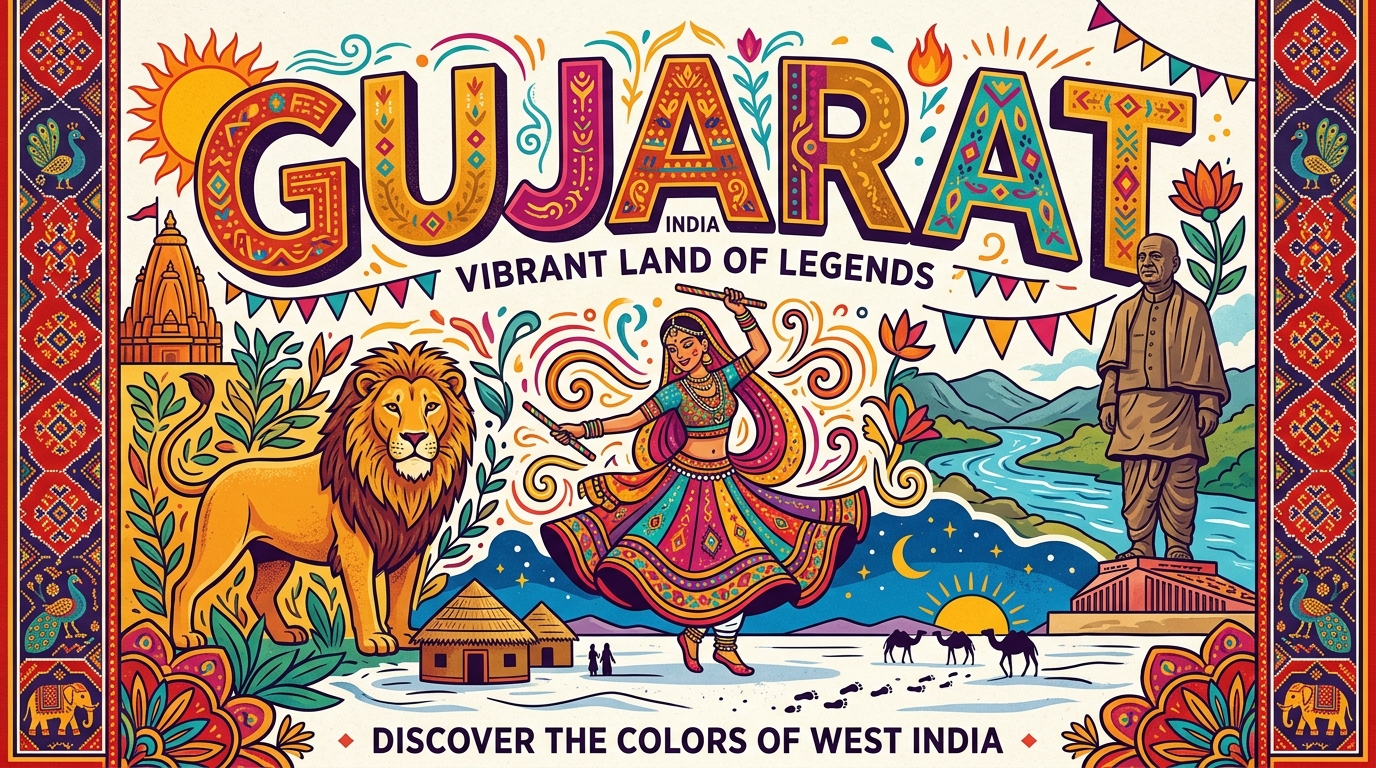
Overview & Heritage
Gujarat • West India
Gujarat anchors India's west coast with the longest coastline of any state — about 1,600 km along the Arabian Sea — from the marshy Rann of Kutch to the temple town of Somnath. At 196,024 km² and a projected 71.5 million people (2025 projection), it is India's fifth-largest state by area, bordered by Pakistan to the northwest, Rajasthan to the north, Madhya Pradesh to the east and Maharashtra to the southeast, with the Gulf of Khambhat cutting deep into its centre. Gandhinagar, a planned city north of Ahmedabad, is the capital, while Ahmedabad — India's first UNESCO World Heritage City — is the commercial and cultural hub. Gujarat is the state students link to two national icons, Mahatma Gandhi born at Porbandar and Sardar Vallabhbhai Patel born at Nadiad, and to three superlatives: it has the only wild Asiatic lions on Earth, the world's tallest statue, and harbours of the Indus Valley Civilization. Known for enterprise, vegetarian cuisine, salt deserts that turn mirror-white in winter, and ports handling a huge share of India's cargo, Gujarat shows how desert, coast and industry coexist in one economy.
“A cornerstone of West India, Gujarat embodies millennia of vibrant history, distinct geography, and legendary cultural traditions.”
History & Dynasties
Gujarat's history is among India's oldest, beginning with the Indus Valley Civilization (about 3300–1300 BCE). Two of its most studied sites lie here: Lothal near Ahmedabad, excavated from 1954, which contains the world's earliest known artificial dockyard dated to about 2400 BCE and bead factories linked to Mesopotamia, and Dholavira in the Rann of Kutch, a 47-hectare fortified city with advanced water reservoirs and an inscription of the famous 10-sign board, inscribed as a UNESCO World Heritage Site in 2021. After the Harappans came Mauryan rule under Ashoka, then the Maitrakas of Vallabhi, and especially the Solanki (Chaulukya) dynasty from the 10th to 13th centuries, whose rulers built the Sun Temple at Modhera and the stepwell Rani ki Vav at Patan (now UNESCO listed). The Gujarat Sultanate from 1407 made Ahmedabad its capital in 1411, before Mughal annexation by Akbar in 1572. In the freedom movement Gujarat was pivotal: Gandhi led the Dandi Salt March in coastal Navsari district in 1930, and Patel integrated 565 princely states after 1947. Modern statehood came when the bilingual Bombay State was divided on linguistic lines; on 1 May 1960, under the Bombay Reorganisation Act, Gujarat was created as a separate state with Ahmedabad as initial capital before Gandhinagar took over in 1970. That 1960 split — Gujarat and Maharashtra born the same day — is a frequently tested reorganization date alongside 1956.
Nature & Geography
Gujarat's terrain is unusually diverse for a mostly flat state. The Great Rann of Kutch, at about 7,500 km², and the Little Rann form one of the world's largest salt marsh deserts, once an arm of the Arabian Sea that silted up and now floods shin-deep during monsoon before drying to a blinding white salt crust in winter. To the southeast, the Kathiawar peninsula holds the Gir hills and the black cotton soil plains of Saurashtra, watered by the Narmada, Tapti, Sabarmati and Mahi rivers — the Narmada being the state's lifeline, dammed at Sardar Sarovar near Kevadia. Climate ranges from arid in Kutch (under 300 mm rain annually) to semi-arid in Saurashtra and humid subtropical in the south near Valsad, with summer temperatures often above 43°C and winter nights near 10°C in the desert. The ecological highlight is Gir National Park and Wildlife Sanctuary in Junagadh district — 1,410 km² of dry teak and acacia forest that is the sole natural habitat of the Asiatic lion (Panthera leo persica). From fewer than 20 lions in 1913, when the Nawab of Junagadh first protected Gir, the population has grown to over 670 lions counted in the 2020 census (now above 700 by recent estimates). Other distinct protected areas are the Wild Ass Sanctuary in the Little Rann — home to the endemic Indian wild ass (ghudkhar) — the Marine National Park and Sanctuary in the Gulf of Kutch with coral reefs and mangroves, Nalsarovar Bird Sanctuary (a Ramsar wetland) visited by flamingos, and Blackbuck National Park at Velavadar.
Culture & Arts
Gujarati is the official language, with Kutchi and Bhili dialects widely spoken in Kutch and the eastern tribal belt. Gujarat's most famous cultural export is Garba — the circular devotional dance with clapping and spinning performed during Navratri — which UNESCO inscribed as Intangible Cultural Heritage in 2023; its faster, stick-based counterpart Dandiya Raas and the tribal Padhar dance light up the state's nine-night festival. Craft traditions are deeply commercial and GI-tagged: Patan Patola double-ikat silk sarees, which can take six months to weave on a single loom, Bandhani tie-dye of Bhuj and Jamnagar, Kutch embroidery with mirrorwork, and Rogan painting in Persiana village where a single Khatri family practices the 300-year-old castor-oil technique. Architecture shows similar distinction: Ahmedabad's walled city (UNESCO 2017) is India's only World Heritage City, Rani ki Vav stepwell (11th century, built by Queen Udayamati) is a UNESCO site with seven levels of sculpture, and Champaner-Pavagadh Archaeological Park is a UNESCO fort city. Food is predominantly vegetarian and famously sweet-savory: dhokla (steamed gram flour cake), thepla, khandvi, undhiyu (winter mixed vegetable), fafda-jalebi and the Gujarati thali with dal, kadhi, rotli and chaas. Major festivals beyond Navratri include the International Kite Festival (Uttarayan) on 14 January and the three-month Rann Utsav that turns the white desert into a tent-city cultural fair. The Statue of Unity at Kevadia — 182 metres, deliberately matching the 182 seats of Gujarat's Legislative Assembly — honours Patel and is the world's tallest statue since 31 October 2018.
Fun Facts
Gir National Park is the only place on Earth where Asiatic lions survive in the wild; after crashing to about 20 in the early 1900s, the population has recovered to over 670 lions in the latest census, with lions now also roaming farms and coast outside the park.
The Statue of Unity on Sadhu Bet island in the Narmada, depicting Sardar Vallabhbhai Patel, stands 182 metres tall (597 feet) — the world's tallest statue since 2018 — and its height was chosen to reflect the 182 seats in Gujarat's Legislative Assembly.
Lothal (about 2400 BCE) contains the world's earliest known artificial dockyard, a brick basin 214 by 36 metres engineered to handle tidal waters of the Sabarmati — a key example of Harappan maritime trade with Mesopotamia.
Gujarat's coastline of about 1,600 km is India's longest, stretching from the Sir Creek marshes (bordering Pakistan) to Daman and supporting two gulfs — the Gulf of Kutch and the Gulf of Khambhat — and the historic ports of Lothal, Mandvi and Kandla.
Dholavira in Kutch, inscribed as a UNESCO World Heritage Site in 2021, is the largest excavated Harappan site in India and contains an exceptional system of 16 interconnected water reservoirs and a signboard with the longest Indus inscription.
Ahmedabad became India's first UNESCO World Heritage City in 2017 for its 600-year-old walled city with 26 ASI-protected monuments, wooden havelis, sultanate gates and institutional architecture by Le Corbusier and Louis Kahn.