
Goa
“Pearl of the Orient with sun-drenched beaches”
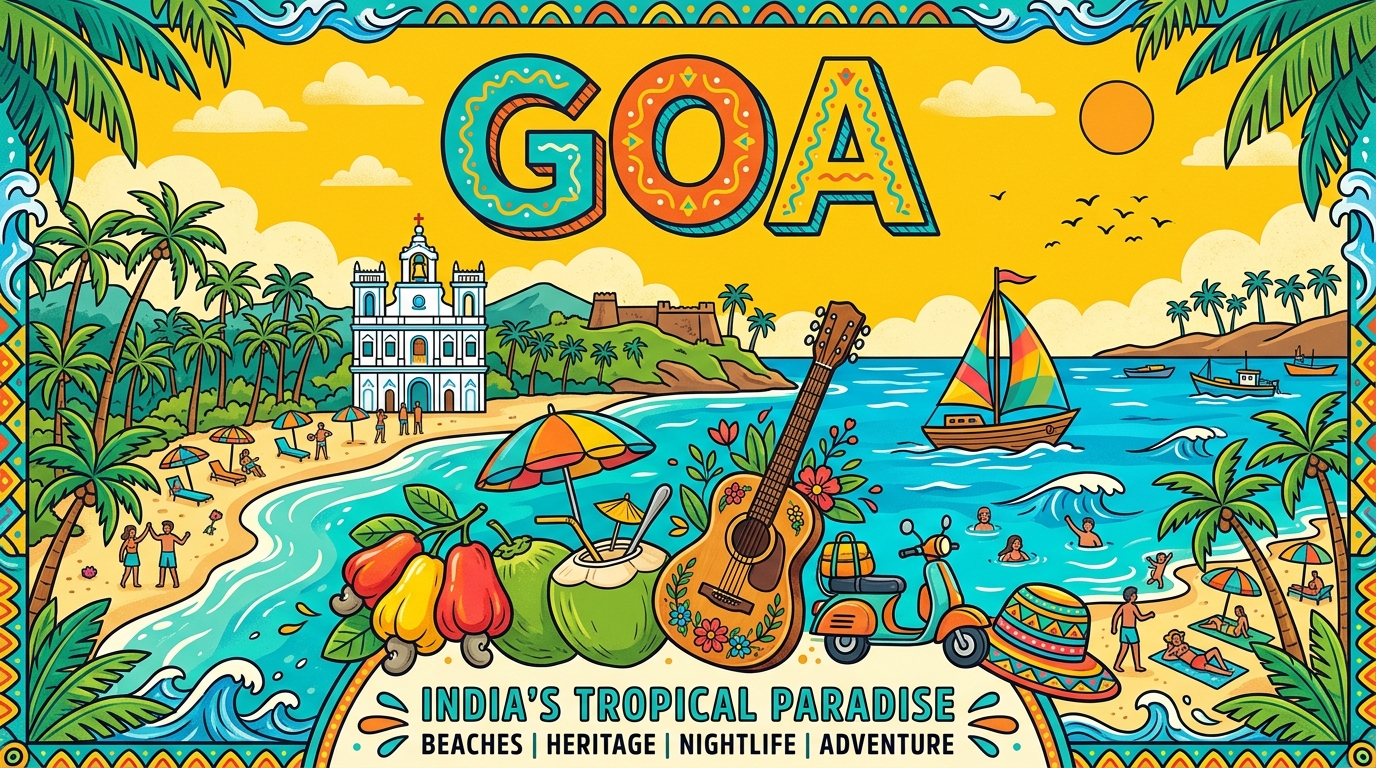
Overview & Heritage
Goa • West India
Goa occupies 3,702 km² along India's southwestern Konkan coast, bounded by Maharashtra to the north, Karnataka to the east and south, and the Arabian Sea to the west. It is India's smallest state by area and the fourth smallest by population, with a projected 1.6 million residents in 2025, yet it has one of the highest per capita incomes and the highest ranking in the national Human Development Index. Panaji on the banks of the Mandovi River is the capital, while Vasco da Gama is the largest city by population and Mormugao its major port. If you picture Goa, hold two images together: Atlantic-facing beaches backed by coconut groves on one side, and forested Western Ghats rising to over 1,000 metres on the other.
“A cornerstone of West India, Goa embodies millennia of vibrant history, distinct geography, and legendary cultural traditions.”
The state's coastline extends about 105–160 km depending on whether estuarine stretches are included — sandy beaches, coves and headlands alternating with the estuaries of the Mandovi and Zuari rivers, between which lies Ilhas de Goa (Tiswadi Island). Inland, laterite plateaus give way to the Sahyadri ranges of the Western Ghats, a UNESCO-recognised biodiversity hotspot. Formerly the capital of Portuguese India for 451 years until liberation in 1961, Goa was a Union Territory with Daman and Diu until it attained statehood on 30 May 1987 after the Konkani language agitation. Konkani written in Devanagari is the official language, with Marathi and English also recognised for official purposes. For students, Goa offers a case study in ecotourism, Indo-Portuguese heritage and high-development small-state economics.
History & Dynasties
Goa's recorded past spans over 20,000 years. Late Paleolithic rock engravings at Usgalimal on the Kushavati River — petroglyphs of animals, tectiforms and labyrinths dated roughly to the Upper Paleolithic-Mesolithic transition — are among the earliest traces of human activity in India and are on UNESCO's tentative list. Laterite Acheulian tools from the Shimoga-Goa Greenstone Belt confirm even earlier hominin presence. Early historical names include Gopakapuri, Gomantak and Govapuri, and ancient texts link the region to the Kadamba dynasty, which ruled from the 2nd to 14th century and founded Old Goa (Govapuri) as a port.
Muslim rule followed with the Bahmani Sultanate and then the Sultanate of Bijapur under Yusuf Adil Shah by 1490, when Goa was a flourishing Arab-trader port. Admiral Afonso de Albuquerque, aided by privateer Timoji, seized Goa in March 1510, lost it, and retook it on 25 November 1510 — St. Catherine's Day — making it the capital of the Estado da Índia. For 451 years Goa served as Portugal's eastern hub; 16th-century Old Goa was among Asia's largest cities, called Golden Goa and Rome of the East. The Goa Inquisition operated from 1560 to 1812.
The capital shifted to Nova Goa (Panaji) in 1843 after epidemics. After diplomatic failures post-1947, India launched Operation Vijay on 17–19 December 1961; the Portuguese surrendered after a 36-hour campaign on 19 December, now Goa Liberation Day. Goa, Daman and Diu became a Union Territory on 19 December 1961. A 1967 Opinion Poll — India's only such referendum — rejected merger with Maharashtra, and after Konkani's inclusion in the Eighth Schedule, Goa became India's 25th state on 30 May 1987.
Nature & Geography
Geographically Goa is sharply zoned. Westward lies the 105–160 km Arabian Sea coast with beaches like Calangute, Baga, Anjuna, Palolem, Agonda and Cola, interspersed with sand dunes, salt pans and fishing harbours. Central Goa is a coastal plain of estuarine rivers — the Mandovi (62 km within Goa) and Zuari (34 km) — that support backwaters, mangroves and the port at Mormugao, while the hinterland rises through forested laterite plateaus to the Western Ghats escarpment in the east.
The Ghats within Goa reach 1,026 metres at Sonsogor Peak and harbour over 1,500 km² of forest cover, about 60% of the state when government and private forests are combined, according to the India State of Forest Report. Bhagwan Mahavir Wildlife Sanctuary and Mollem National Park (107 km²) protect evergreen forest and form part of a contiguous tiger corridor linked to Karnataka's Anshi-Dandeli. Bondla and Cotigao sanctuaries, plus Dr. Salim Ali Bird Sanctuary on Chorao Island in the Mandovi estuary, shelter mangrove specialists, hornbills and crocodiles. Climate is tropical monsoon: summer highs near 32°C tempered by sea breeze, monsoon June–September bringing about 3,000 mm rainfall — among India's wettest — and warm, humid winters ideal for tourism. Dudhsagar Falls on the Karnataka border, often cited at 310 metres as a four-tiered cataract (flag: height measurements vary between 300–320 m by source), drops from the Ghats through dense deciduous forest and is fed primarily by the Mandovi headwaters. The economy of spice plantations around Ponda, with pepper, cardamom and cashew, links geography directly to trade history.
Culture & Arts
Goan culture is a living synthesis of Konkani Hindu and Catholic Portuguese traditions unmatched elsewhere in India. The historic churches and convents of Old Goa — including Sé Cathedral, the largest church in Asia; St. Francis of Assisi; St. Cajetan modelled on St Peter's in Rome; and the Basilica of Bom Jesus — were inscribed as a UNESCO World Heritage Site in 1986. The Basilica, completed in 1605 in baroque style, holds the embalmed remains of St. Francis Xavier in a glass casket. Hindu temple architecture adapts to this synthesis: Shantadurga at Kavle, Mangueshi, Mahalasa and Tambdi Surla's 12th-century Mahadev Temple in basalt show sloping tiled roofs and deepastambhas rather than northern shikharas.
In Panaji, Fontainhas — the Latin Quarter — retains narrow lanes, azulejo-tiled porches and balconies painted in indigo and ochre, protected as a heritage zone. The Goan Carnival, introduced by the Portuguese as pre-Lenten revelry, is now a state-sponsored three-day parade led by King Momo each February; Shigmo, Chavoth (Ganesh Chaturthi), Samvatsar Padvo and Christmas together mark a shared calendar. Language: Konkani is spoken in multiple dialects — Antruz, Baru, Saxti — and is written in Devanagari officially, Roman script by Catholics, and Kannada script near Karwar; Marathi and English retain official status for historical and administrative use.
Cuisine reflects the blend: fish curry-rice (xit-kodi) with kokum and coconut, prawn balchão, pork vindaloo and sorpotel derived from Portuguese carne de vinho e alhos, bebinca layered dessert, and cashew feni, a double-distilled spirit from cashew apples granted Geographical Indication in 2009 and distilled traditionally in clay pots. Music integrates violin, guitar and mando — Konkani folk songs depicting social satire — and fado-influenced cantars. Architecture, food and festival calendars thus make Goa a textbook example of creolisation.
Fun Facts
Goa is India's smallest state by area at 3,702 km² — about one-thirtieth the size of Rajasthan — and consistently ranks first or second nationally in GDP per capita, more than twice the national average and flagged as having India's highest quality of life in several national assessments.
Portugal ruled Goa for 451 years (1510–1961), longer than British rule over any part of mainland India and one of the longest continuous colonial periods in world history.
The Basilica of Bom Jesus (1605) in Old Goa holds the mortal remains of St. Francis Xavier, co-founder of the Jesuit order, who died in 1552; his body has shown unusual preservation and is displayed every ten years at the Exposition.
Dudhsagar Falls, on the Mandovi River at the Goa-Karnataka border, is a four-tiered waterfall cited at about 310 metres height, whose name means sea of milk for its white foam during monsoon flows.
Cashew feni, distilled from fermented cashew apples without added spirits, is Goa's only Geographical Indication-tagged alcoholic beverage, with a distinct method registered in 2009.
Usgalimal rock engravings on laterite platforms along the Kushavati River, dated to the Upper Paleolithic/Mesolithic, are among India's oldest surviving art and have been placed on UNESCO's tentative World Heritage list.