
Delhi
“The historic heart and capital of India”
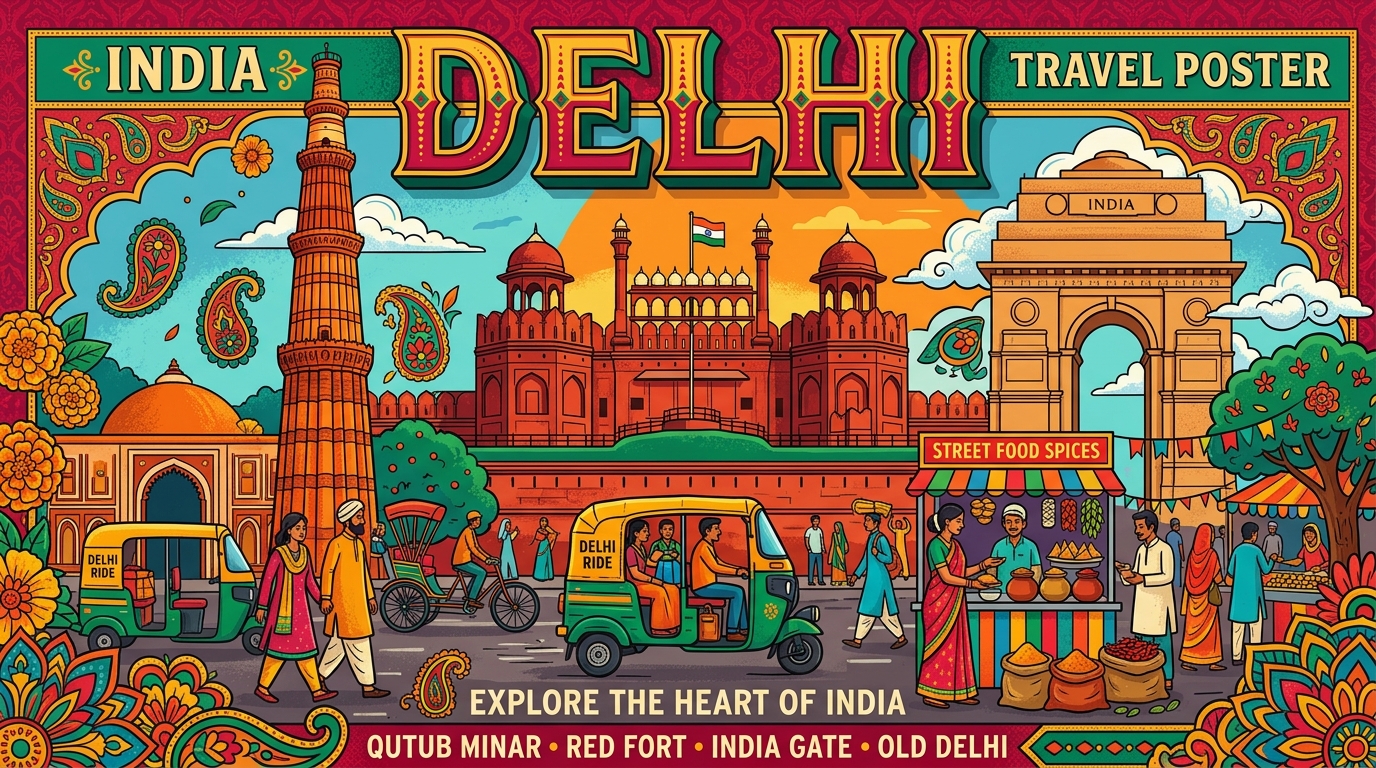
Overview & Heritage
Delhi • Union Territory India
Delhi, officially the National Capital Territory (NCT) of Delhi, occupies 1,484 km² along both banks of the Yamuna River in northwestern India, enclaved on three sides by Haryana and bounded eastward by Uttar Pradesh. With a projected population of about 21.3 million in 2025, it is India's most populous city-territory and second most populous urban agglomeration, functioning simultaneously as a Union Territory, a city-state with an elected legislative assembly, and the seat of the national government where New Delhi — the purpose-built administrative enclave within Delhi — serves as the capital of India. If you picture one framework, picture a metropolis where seven historical cities lie layered upon one terrain, with medieval bazaars, Mughal tombs and British avenues coexisting beside metro lines and university campuses.
“A cornerstone of Union Territory India, Delhi embodies millennia of vibrant history, distinct geography, and legendary cultural traditions.”
Delhi became a Union Territory on 1 November 1956 and was re-designated the National Capital Territory in 1991 through the 69th Constitutional Amendment and the Government of NCT of Delhi Act, with further clarifications in 2023. It covers 11 administrative districts, ranges from about 213 to 318 metres in elevation on the Delhi Ridge, and at 700 km² of urbanised area remains India's largest city by built-up extent. Official languages are Hindi, English, Punjabi and Urdu, reflecting waves of migration, particularly the post-Partition arrival of Punjabi refugees in 1947. For students, Delhi is essential: nearly every major period of Indian history — ancient, Sultanate, Mughal, colonial and post-Independence — has left a tangible, visitable layer here.
History & Dynasties
Tradition identifies Delhi with Indraprastha, the capital of the Pandavas described in the Mahabharata, sited on a knoll near Purana Qila on the Yamuna. Archaeology near the fort has yielded Painted Grey Ware from around 1000 BCE, though no definitive Indraprastha fortifications have been identified. Recorded history begins in the 8th century when the Tomara Rajputs founded Lal Kot around 736 CE; the Chauhan king Prithviraj III extended it as Qila Rai Pithora before his defeat by Muhammad Ghori in the Second Battle of Tarain in 1192, marking the start of sustained Muslim rule in north India.
From 1206 Delhi was the capital of the Delhi Sultanate through five dynasties — Slave, Khilji, Tughlaq, Sayyid and Lodi — who built cities including Siri, Tughlaqabad, Jahanpanah and Firozabad. Qutb-ud-din Aibak began the Qutb Minar in 1199 and Iltutmish completed it, while later sultans added forts and reservoirs still visible across South Delhi. In 1526 Babur defeated Ibrahim Lodi at Panipat, founding the Mughal Empire; Humayun ruled briefly from Delhi before Sher Shah Suri built Purana Qila during 1540–1545.
The Mughals returned the capital to Delhi in 1639 when Shah Jahan founded Shahjahanabad, the walled seventh city with the Red Fort, Jama Masjid (completed 1656) and Chandni Chowk. After Aurangzeb, Delhi was sacked by Nader Shah in 1739, held by Marathas in 1757 and seized by the British in 1803. The Rebellion of 1857 centred on Delhi under Bahadur Shah Zafar. In 1911 King George V announced the shift from Calcutta to New Delhi, planned by Edwin Lutyens and Herbert Baker and inaugurated in 1931. At Partition in 1947 Delhi absorbed large refugee populations and became the capital of independent India.
Nature & Geography
Delhi lies at 28°37'N 77°14'E on the Indo-Gangetic plain, straddling the Yamuna floodplain and the Delhi Ridge, which is the northernmost extension of the ancient Aravalli Range. The Ridge — an eroded, 1.5 billion-year-old fold range — forms a forested spur encircling the west, northeast and northwest of the city, reaching 318 metres at Bhatti Mines, and is subdivided into the Northern, Central, South-Central and Southern Ridge. The Yamuna, the territory's only major river, flows for about 48 km through Delhi, traditionally forming the boundary with Uttar Pradesh; its floodplain provides fertile alluvium but is critically polluted by urban discharge, a major environmental challenge for students to study.
About 783 km² of Delhi is designated rural and 700 km² urban; forest and tree cover totals roughly 19–20% as per the India State of Forest Report 2023, including the Ridge forests of acacia, neem, dhak and scrub. Climate is humid subtropical and semi-arid: summers from April to June regularly exceed 45°C, sometimes approaching 50°C; monsoon brings about 800 mm rainfall from July to September with high humidity and flooding risks; winters from November to February drop to 2–5°C with dense smog and fog that frequently impairs air quality.
Despite dense urbanisation, protected areas persist: Asola Bhatti Wildlife Sanctuary on the Southern Ridge — Delhi's only wildlife sanctuary at about 32 km² — harbours over 300 bird species, nilgai, jackals and leopards occasionally dispersing from nearby Aravalli corridors; Yamuna Biodiversity Park restores floodplain habitat; and heritage parks like Lodhi Gardens (built around 15th-century tombs), Garden of Five Senses and Sundar Nursery combine ecology with archaeology. Delhi falls in seismic zone IV, indicating high earthquake vulnerability.
Culture & Arts
Delhi's culture is composite rather than monolithic, formed by layering Rajput, Turkic, Mughal, Persian, British and Punjabi influences. Three sites — Qutb Minar complex, Humayun's Tomb and the Red Fort — are inscribed as UNESCO World Heritage Sites, all from the Sultanate-Mughal period. Humayun's Tomb, completed in 1572 with Persian charbagh gardens, is considered the prototype for the Taj Mahal's design. Other significant monuments include India Gate (All India War Memorial), Jantar Mantar observatory built by Maharaja Jai Singh II in 1724, Purana Qila, Safdarjung's Tomb, Lodhi Tombs and over 1,200 heritage buildings recognised by the Archaeological Survey of India.
Language illustrates this fusion: Delhi's Khariboli dialect contributed to the rise of both modern Hindi and Urdu; Ghalib and Mir Taqi Mir are among the poets associated with the city, and Amir Khusrau developed early qawwali and qaul traditions here under Nizamuddin Auliya. Today Hindi, Urdu, Punjabi and English dominate public life, with festivals celebrated across communities.
Cuisine is a major cultural marker: Old Delhi's Chandni Chowk offers parathas in the historic Paranthe Wali Gali, jalebis, kebabs, biryani, chhole bhature and dahi bhalla; post-Partition Punjabi influence added butter chicken — invented in the 1950s at Delhi's Moti Mahal — dal makhani and tandoori cooking; and Mughlai staples remain central. Festivals are observed at national scale: Republic Day Parade on Kartavya Path (formerly Rajpath) from the Rashtrapati Bhavan to India Gate, Independence Day address from the Red Fort, Diwali, Eid, Holi, Durga Puja at Chittaranjan Park, Lohri, Guru Nanak Jayanti, Christmas, and the composite flower festival Phool Walon Ki Sair at Mehrauli, where flowers are offered at both the Sufi shrine of Khwaja Bakhtiyar Kaki and the Yogmaya Temple.
Fun Facts
The Qutb Minar, at 72.5 metres, is the tallest brick-built minaret in the world, begun by Qutb-ud-din Aibak in 1199 and completed by Iltutmish around 1220, with intricate sandstone carvings and inscriptions.
Humayun's Tomb, commissioned in 1565 by Empress Bega Begum and completed in 1572, was the first garden-tomb on the Indian subcontinent and directly inspired the design of the Taj Mahal.
Khari Baoli in Old Delhi, established in 1650 near the Fatehpuri Mosque, is Asia's largest wholesale spice market, trading spices, nuts and herbs in a step-well (baoli)-named lane since the 17th century.
The Delhi Metro, operational since 24 December 2002, extends over 390 km with more than 285 stations (as of 2024) and carries over 6 million passengers on peak days, powered increasingly by solar energy from its Rewa plant allocation (flag: exact daily ridership varies seasonally).
Delhi's public bus and auto fleet pioneered large-scale CNG conversion beginning in 1998 following a Supreme Court directive, making it one of the world's largest CNG-based public transport networks.
Traditionally associated with seven historical cities — from ancient Indraprastha and Qila Rai Pithora through Siri, Tughlaqabad, Jahanpanah and Firozabad to Shahjahanabad — Delhi is often called the city built, destroyed and rebuilt seven times, a favourite framing in history examinations.