
Chandigarh
“The City Beautiful designed by Le Corbusier”
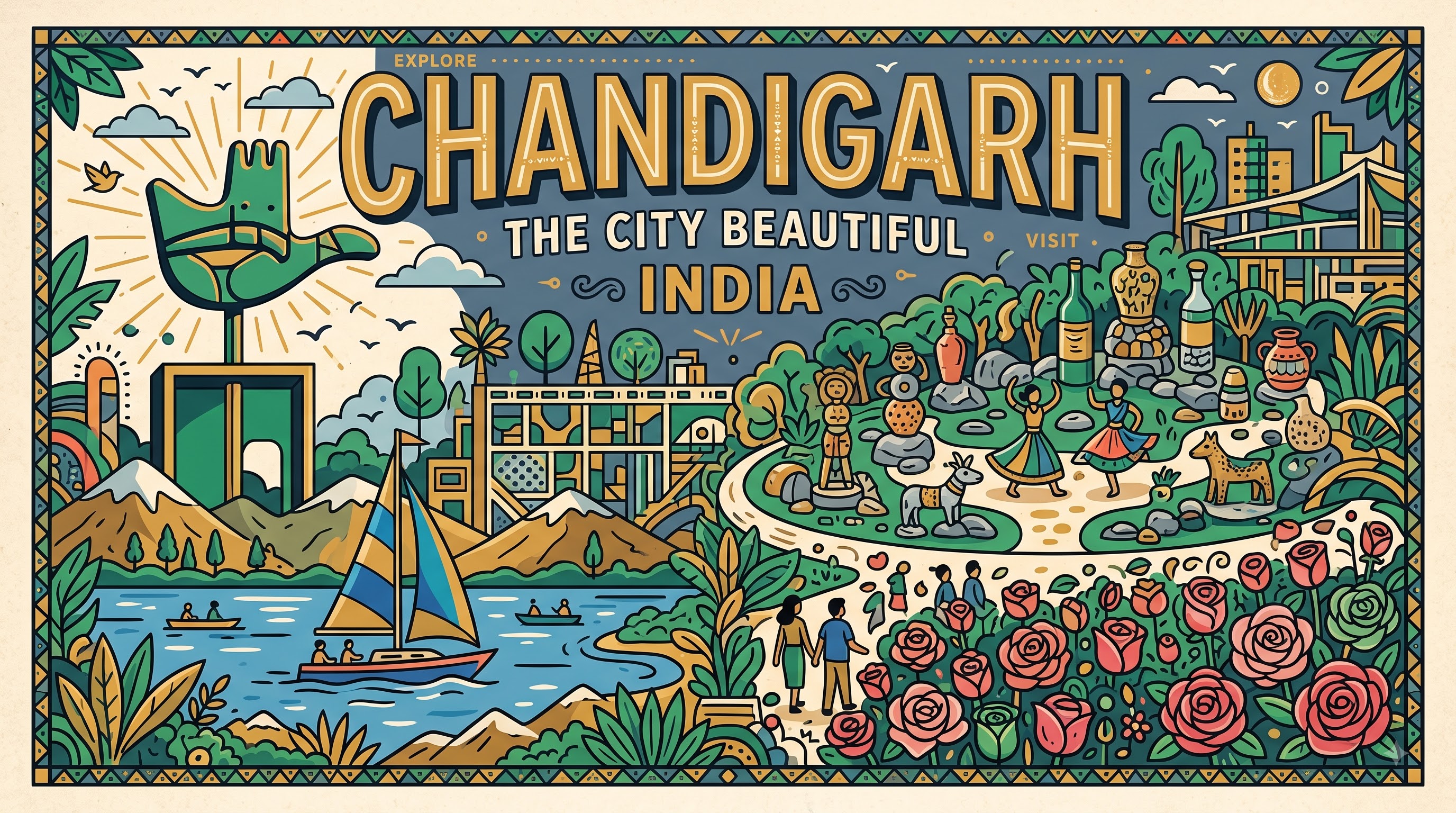
Overview & Heritage
Chandigarh • Union Territory India
Chandigarh occupies 114 km² at the foothills of the Shivalik Hills, where the Indo-Gangetic plain meets the Himalayan rise, about 265 km northwest of New Delhi. With a projected population of about 1.2 million in 2025, it is simultaneously a city, a district and a Union Territory, uniquely serving as the shared capital of two states — Punjab and Haryana — while being administered directly by the central government. If you picture one thing, picture a grid of green, self-contained sectors connected by seven types of roads, where low-slung modernist concrete buildings sit within tree-lined avenues, lakes and gardens — a deliberate contrast to India's older, organically grown cities.
“A cornerstone of Union Territory India, Chandigarh embodies millennia of vibrant history, distinct geography, and legendary cultural traditions.”
Chandigarh was India's first planned city after Independence, conceived as a symbol of a new, forward-looking nation after Lahore, the former capital of undivided Punjab, was lost to Pakistan in 1947. Its tagline, "The City Beautiful," derives from the City Beautiful movement that influenced its planners. The city's literacy rate exceeds 93% and its human development indicators rank among the highest nationally. Designated in 1966 as a Union Territory after Punjab was reorganised on linguistic lines, Chandigarh remains a case study for students of urban planning, architecture and federal governance, offering lessons in how design choices shape daily life, traffic, housing and public health.
History & Dynasties
Before 1947, the site was agricultural land dotted with 58 villages and mango groves on the plain between the Sukhna and Patiala choes (seasonal streams). Partition left East Punjab without a capital, and temporary administrative offices were scattered across Shimla, Jalandhar and other towns. In March 1948 the Government of Punjab, in consultation with the Government of India, selected a gently sloping tract at the foot of the Shivaliks for a new capital, valued for its central location, water availability, drainage and setting against blue hills. Prime Minister Jawaharlal Nehru described the project as unfettered by the traditions of the past.
An American firm, Mayer, Whittlesey and Glass, was commissioned in 1950. Albert Mayer and Matthew Nowicki drafted a fan-shaped garden-city plan with curvilinear roads and superblocks. After Nowicki died in a plane crash in 1950, Mayer withdrew. The government then recruited Swiss-French architect Le Corbusier in late 1950, who arrived in February 1951 with Pierre Jeanneret, Maxwell Fry and Jane Drew. Le Corbusier retained the site but replaced the organic plan with a rectilinear grid, increasing density by about 20% and organising the city into numbered sectors — neighbourhood units of about 800 by 1,200 metres, each with its own market, school and park.
Construction began in 1952 and the city was inaugurated in October 1953, with about 2,000 of the initial 20,000 acres reserved for parks. When Punjab was bifurcated in 1966, Chandigarh was made a Union Territory and confirmed as joint capital of Punjab and Haryana. The Capitol Complex — Palace of Assembly, High Court and Secretariat — conceived as the head, with Sector 17 as the heart and Leisure Valley as lungs, was inscribed as a UNESCO World Heritage Site in 2016 as part of The Architectural Work of Le Corbusier.
Nature & Geography
Chandigarh lies at 30°45'N, 76°48'E, at an elevation of 304 to 365 metres above sea level. Geologically it sits on alluvial deposits of boulders, gravel, sand and kankar laid down by the Shivaliks, with two main seasonal rivulets — the Sukhna Choe in the east and Patiala-ki-Rao in the west — defining its edges. The central water divide is drained by smaller choes through the Leisure Valley, a continuous green belt that Le Corbusier described as the lungs of the city.
Climate is humid subtropical with strong extremes: summer highs regularly exceed 44°C from April to June, winter nights can drop to 2–5°C with dense fog in December and January, and monsoon rainfall averages about 1,100 mm between July and September. Despite its small size, the city reports over 35% green cover, one of the highest for an Indian city, maintained through banning of roadside tree felling without replacement and a network of over 1,800 small and large parks.
Sukhna Lake, a 3 km² artificial reservoir created in 1958 by damming the Sukhna Choe, is a protected wetland and popular migratory bird site in winter, hosting ducks, geese and Siberian visitors. The Rock Garden, begun secretly in 1957 by Public Works employee Nek Chand on a forest buffer, now spans 40 acres of interlinked courtyards and waterfalls built entirely from industrial waste, broken ceramics, bangles and tiles, and opened to the public in 1976. Zakir Hussain Rose Garden in Sector 16, spread over 27 acres and established in 1967, claims to be Asia's largest rose garden with about 825 rose varieties and more than 32,500 other medicinal plants. Other notable spaces include the Garden of Fragrance, Butterfly Park and the Japanese Garden in Sector 31.
Culture & Arts
Chandigarh's culture is modernist by design and Punjabi by lived experience. Officially English is the Union Territory's administrative language, with Hindi and Punjabi widely spoken at home due to proximity to both states. Residents often identify as Chandigarhians rather than by state affiliation, reflecting the city's cosmopolitan migrant population drawn by government service, Panjab University, the Postgraduate Institute of Medical Education and Research (PGIMER), and the nearby Rajiv Gandhi Chandigarh Technology Park.
Architectural culture dominates civic identity. The Open Hand Monument — a 26-metre high rotating metal sculpture of an open palm designed by Le Corbusier — symbolises "open to give, open to receive" and forms the official emblem. The Capitol Complex, Gandhi Bhawan at Panjab University, and the Government Museum and Art Gallery in Sector 10 are key modernist landmarks. Residential architecture is tightly controlled through Frame Control and zoning regulations to preserve sightlines.
Food and festivals blend Punjabi warmth with sector-level community life. Eating out in open-air plazas like Sector 17 and Elante Courtyard, and cycling along dedicated tracks reflects the planned emphasis on pedestrian circulation. Festivals celebrated with scale include Baisakhi, Lohri, Dussehra and the Chandigarh Carnival in Sector 42, alongside the Rose Festival held every February in Zakir Hussain Rose Garden, which draws horticulturists and photographers with flower shows and competitions. Theatre at Tagore Theatre, music at Pracheen Kala Kendra, and hockey at Sector 42 Stadium complete a public culture built around leisure, education and sport rather than traditional temple or bazaar centres.
Fun Facts
Le Corbusier conceived the master plan as analogous to the human body: the Capitol Complex (Sector 1) as the head, Sector 17 City Centre as the heart, Leisure Valley parks as lungs, educational institutions as intellect, roads as circulatory system, and industrial area as viscera.
The Rock Garden was built illegally and in secret for 18 years (1957–1975) by Nek Chand Saini, a road inspector, on a protected forest gorge near Sukhna Lake before authorities discovered it; public protest saved it from demolition and it was inaugurated in 1976.
Chandigarh's Capitol Complex was inscribed on the UNESCO World Heritage List in 2016 along with 16 other Le Corbusier sites across seven countries, representing his contribution to the Modern Movement.
The Open Hand Monument stands 26 metres high, weighs 50 tonnes and rotates in the wind; Le Corbusier intended it as a symbol of peace and reconciliation after Partition.
Zakir Hussain Rose Garden in Sector 16 covers about 27 acres and houses around 825 varieties of roses plus more than 32,500 trees and medicinal plants, making it Asia's largest dedicated rose garden.
The city is divided into numbered sectors from 1 to 56, with striking absence of Sector 13 — omitted because Le Corbusier considered 13 unlucky — and odd-even road naming to aid navigation.