
Bihar
“Cradle of ancient empires and enlightenment”
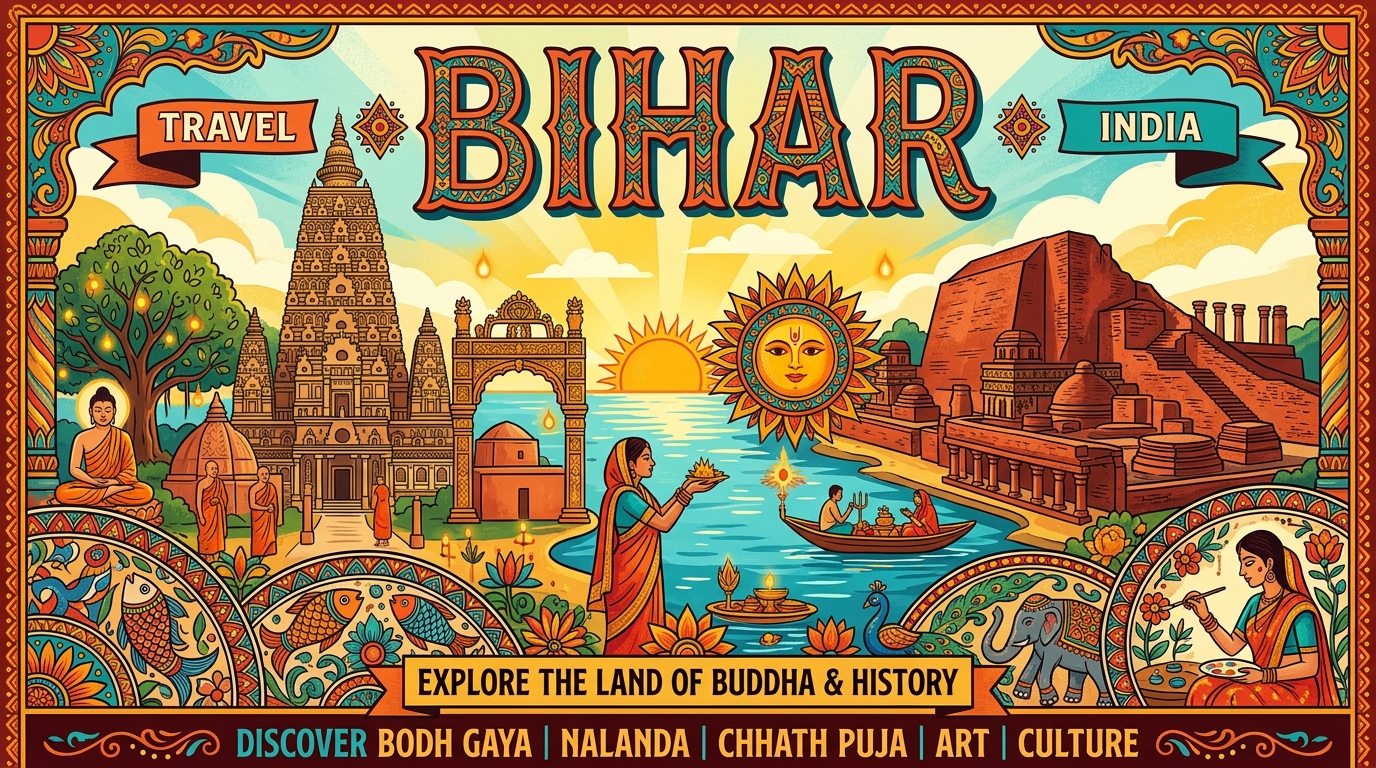
Overview & Heritage
Bihar • East India
Bihar sits in the fertile Gangetic plains of eastern India, bordered by Nepal to the north and West Bengal, Uttar Pradesh, and Jharkhand on its other sides. If you only remember one thing about Bihar, remember this: it is the birthplace of two of the world's major religions — Buddhism and Jainism — and the home of India's first great empires. Ancient Pataliputra (modern Patna) was once the largest city in the world and the capital of the Mauryan and Gupta empires. Today Bihar is India's third most populous state, with over 130 million people (2025 projection), and a predominantly agrarian economy fed by the Ganga, Kosi, Gandak, and Son rivers. Known for its intellectual heritage, resilience, and vibrant festivals like Chhath Puja, Bihar remains a cornerstone of Indian civilization and a key state for anyone studying Indian history, politics, or culture.
“A cornerstone of East India, Bihar embodies millennia of vibrant history, distinct geography, and legendary cultural traditions.”
History & Dynasties
Bihar's history is the history of ancient India itself. The region was known as Magadha in antiquity, one of the sixteen Mahajanapadas. The Haryanka dynasty founded by Bimbisara (c. 544 BCE) made Rajgir its capital, later shifted to Pataliputra by his son Ajatashatru. From this base rose the Nanda dynasty and then the Maurya Empire in 322 BCE, founded by Chandragupta Maurya with guidance from the strategist Chanakya. Under Emperor Ashoka the Great in the 3rd century BCE, the empire stretched across most of the subcontinent; after witnessing the carnage of the Kalinga War, Ashoka embraced Buddhism, erected his famous pillars and edicts, and sent missions across Asia.
After the Mauryas came the Shunga and then the Gupta Empire from the 4th to 6th centuries CE — often called India's Golden Age — when science, mathematics, and Sanskrit literature flourished and Nalanda University (founded 5th century CE) became the world's first great residential university, hosting over 10,000 students and a 9-million manuscript library until its destruction around 1200 CE. Vikramshila, another famed university, was founded by Pala king Dharmapala in the 8th century.
Medieval Bihar saw rule by Palas, Karnats, and later Turk-Afghan sultans, with Nalanda and Vikramshila declining after Bakhtiyar Khilji's incursions. In modern history, Bihar was a center of the 1857 uprising at Patna and Arrah, and of Gandhi's first Satyagraha at Champaran in 1917, where he championed indigo farmers against British planters. As per government data, Bihar was formed as a province in 1912 and achieved its current boundaries after Jharkhand was carved out as a separate state on 15 November 2000.
Nature & Geography
Bihar is almost entirely part of the Indo-Gangetic plain, with an average elevation of about 53 meters and exceptionally fertile alluvial soils renewed each year by monsoon floods. The Ganga flows west to east for more than 400 km across the state, joined by Himalayan tributaries — the Ghaghara, Gandak, Bagmati, Kosi (notoriously called the 'Sorrow of Bihar' for its course shifts), and Son from the south. North Bihar lies in the wet, subtropical lowlands at the foot of the Himalayas, while South Bihar is slightly higher, rockier, and framed by the Kaimur and Rajgir hills.
Climate is humid subtropical: summers are intensely hot (often above 40°C), monsoon rainfall from June to September is heavy, and winters are cool and foggy. Although forest cover is among the lowest in India at under 8%, Bihar protects important ecosystems. Valmiki National Park and Tiger Reserve in West Champaran, on the Nepal border, is the state's only national park and tiger reserve, sheltering Bengal tigers, leopards, sloth bears, and Indian bison within dense sal and riverine forests. Vikramshila Gangetic Dolphin Sanctuary near Bhagalpur is India's only protected area for the endangered Ganges river dolphin, the national aquatic animal. Further south, Rajgir's hills, Kakolat Falls, and the wetlands of Kanwar Lake (a Ramsar site) offer bird habitat and geological interest.
Culture & Arts
Bihar's culture is defined by depth rather than display. The Maithil culture of the Mithila region is renowned for Madhubani (Mithila) painting, a UNESCO-recognized intangible tradition where women artists use natural dyes, rice paste, and fingers or twigs to create geometric and mythological motifs on walls and paper. The state's most heartfelt festival is Chhath Puja, the only Vedic festival dedicated to Surya, the Sun God, where devotees fast and offer prayers at sunset and sunrise standing in rivers — a spectacle of devotion along the Ganga at Patna.
Languages reflect Bihar's diversity: Hindi and Urdu are official, but Maithili (recognized in the 8th Schedule), Bhojpuri, Magahi, and Angika are widely spoken at home. Classical heritage includes ancient centers of learning and the birthplaces of Lord Mahavira at Vaishali and Guru Gobind Singh at Patna Sahib. Modern Bihari cuisine is earthy and protein-rich: litti-chokha (roasted wheat balls stuffed with sattu gram flour, served with mashed brinjal and tomato), sattu paratha, khaja from Silao, and Thekua during Chhath. Folk music like Purvi and Sohar, and dances like Jat-Jatin and Bidesia theatre, carry stories of migration, love, and everyday struggle, keeping an oral tradition alive for students of literature and anthropology.
Fun Facts
Bodh Gaya's Mahabodhi Temple marks the exact spot where Prince Siddhartha Gautama attained enlightenment under the Bodhi Tree around the 6th century BCE; it is a UNESCO World Heritage Site and the most sacred pilgrimage site for Buddhists worldwide.
Nalanda University housed over 10,000 students and 2,000 teachers from across Asia (China, Korea, Tibet) and its library reportedly burned for three months when destroyed — as per historical accounts by Persian chroniclers (flag: exact burn duration debated by historians).
Vaishali, in present-day Bihar, hosted the Licchavi republic in the 6th century BCE, considered by many historians to be one of the world's earliest republics with an elected assembly.
Patna's Golghar, a huge granary built by the British in 1786 after the 1770 famine, has no pillars inside and its walls are 3.6 meters thick at the base — designed to store grain for the army.
Bihar produces over 70% of India's makhana (fox nuts), a superfood now exported worldwide, with Mithila Makhana recently receiving a GI tag.
As per Census 2011 data, Bihar is the most densely populated state in India among major states, with over 1,100 people per square kilometre — a key figure often asked in competitive exams.