
Assam
“Land of red rivers and blue hills”
Overview & Heritage
Assam • Northeast India
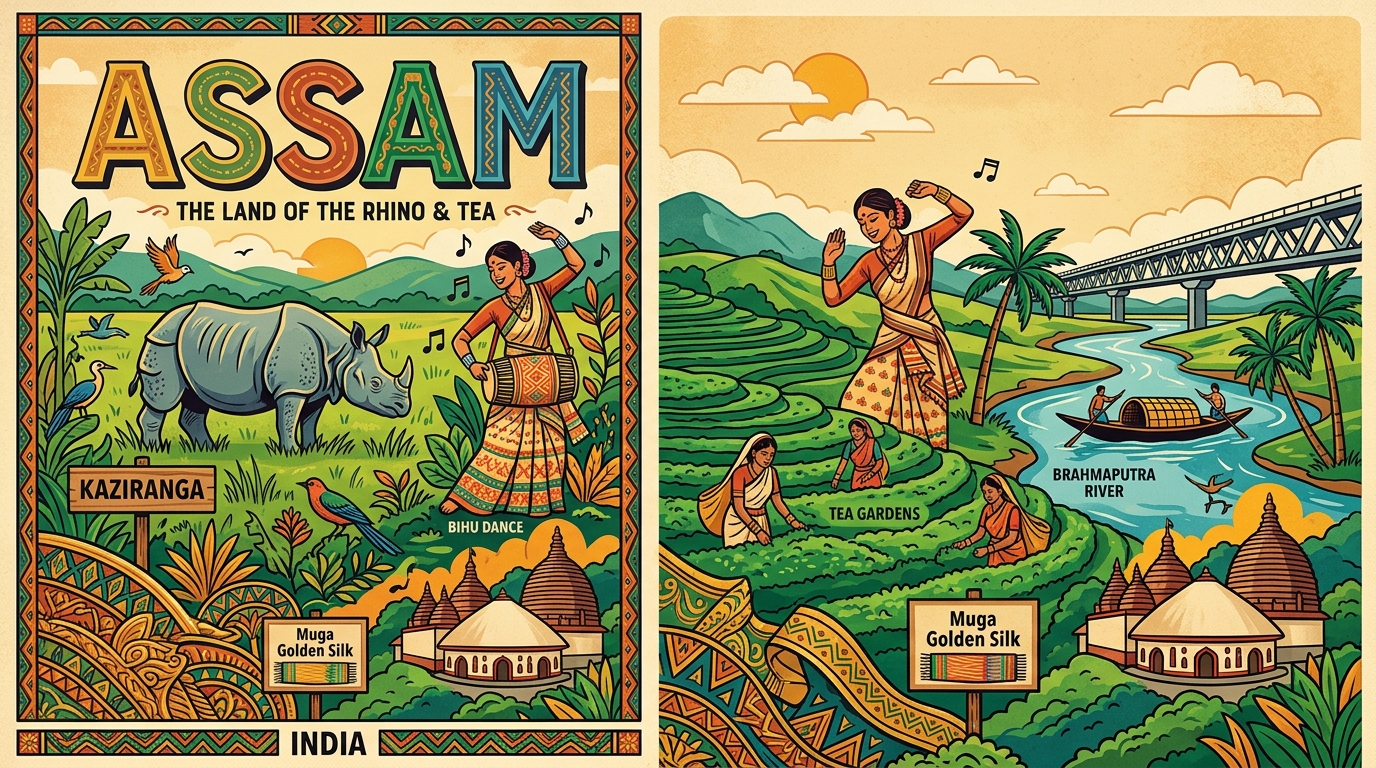
Assam is the gateway to Northeast India, a long river valley state built around the Brahmaputra where blue hills meet floodplains that turn emerald every monsoon. At 78,438 km² with a projected 35.7 million people (2025 projection), it is the most populous state in the Northeast and the one most students encounter first when studying the region. Dispur, a locality within Guwahati, serves as the capital, while Guwahati itself is the Northeast's largest city and transport hub. Bordered by Bhutan and Arunachal to the north, Nagaland and Manipur to the east, Meghalaya, Tripura and Mizoram to the south, and West Bengal and Bangladesh to the west, Assam sits at a cultural crossroads. Its shorthand features are instantly recognizable: endless tea gardens that produce more than half of India's tea, the one-horned rhinoceros roaming tall grasslands, golden Muga silk that shimmers with every wash, and the Brahmaputra — India's only 'male' river and one of Asia's largest — flowing 640 km through the state. For students of environment, history and economics, Assam matters because it holds two UNESCO World Heritage natural sites, a 600-year dynasty that resisted the Mughals, and some of India's earliest oil fields.
“A cornerstone of Northeast India, Assam embodies millennia of vibrant history, distinct geography, and legendary cultural traditions.”
History & Dynasties
Assam's classical name was Kamarupa, ruled by the Varman and later Pala dynasties from the 4th to 12th centuries, when the Kamakhya Temple complex became a major Shakti Peetha. The defining chapter, however, was the Ahom dynasty from 1228 to 1826, nearly 600 years of continuous rule — the longest by any dynasty in Indian history. Founded by the Tai prince Chaolung Sukaphaa, who entered via the Patkai hills from present-day Myanmar, the Ahoms built a sophisticated administration noted for the Buranji chronicles, among India's earliest historical writings, and for wet-rice statecraft around Sivasagar, their final capital with the Rang Ghar — Asia's oldest surviving amphitheatre — and the 200-year-old Talatal Ghar palace. Crucially for exams, the Ahoms famously repelled Mughal invasions seventeen times; the climax was the Battle of Saraighat in 1671, when general Lachit Borphukan defeated the Mughal admiral Ram Singh on the Brahmaputra at Guwahati, a victory still commemorated as Lachit Divas on 24 November. Decline followed Burmese invasions, and after the First Anglo-Burmese War, the Treaty of Yandabo in 1826 ceded Assam to the British. Colonial Assam became a laboratory for resource extraction: Robert Bruce discovered wild tea in 1823, the first commercial tea garden was planted at Chabua in 1837, and Asia's first oil well was drilled at Digboi in 1889, with its refinery running from 1901. Assam became a constituent state of India in 1950; since then its map has shrunk as Nagaland (1963), Meghalaya (1972), Mizoram (1987) and Arunachal (1987) were carved out, while internal statehood demands led to Bodo Territorial Region autonomy. The anti-foreigners Assam Agitation (1979–85) leading to the Assam Accord remains a key modern milestone.
Nature & Geography
Two valleys define Assam: the vast Brahmaputra valley to the north, 600 km long but sometimes just 80 km wide, hemmed by the Himalayas and the Karbi and Barail hills, and the smaller Barak valley to the south draining into Bangladesh. The Brahmaputra dominates everything — a braided, flood-prone giant that carries Himalayan silt, creates fertile floodplains, and reshapes islands each monsoon. Climate is humid subtropical with among India's highest rainfall; Assam receives 1,500–2,500 mm annually, with summer temperatures around 30–35°C and cool, foggy winters. This water abundance underpins extraordinary biodiversity. Kaziranga National Park, a UNESCO World Heritage Site since 1985 along the Brahmaputra, shelters more than 2,600 greater one-horned rhinoceroses — over two-thirds of the global population — alongside the highest density of tigers among protected areas in the world, plus elephants, wild buffalo and Gangetic dolphins. Manas National Park, also UNESCO-inscribed (and both a tiger reserve and biosphere reserve) on the Bhutan border, protects golden langur and pygmy hog. In midstream Brahmaputra lies Majuli, officially recognized by Guinness World Records as the world's largest inhabited river island at about 352 km² (though shrinking due to erosion from over 1,250 km² a century ago) and on UNESCO's tentative heritage list for its cultural landscape. Other key habitats are Pobitora Wildlife Sanctuary, which has the world's highest concentration of one-horned rhino per km², Dibru-Saikhowa National Park famous for feral horses, Nameri, and the deep freshwater wetland Deepor Beel, a Ramsar site west of Guwahati vital for migratory birds.
Culture & Arts
Assamese culture blends Indo-Aryan, Tibeto-Burman and Ahom Tai influences. Assamese and Bodo are official languages, with Bengali widely spoken in Barak valley and Mishing, Karbi and Dimasa in tribal areas. The spiritual founder figure for students to know is Srimanta Sankardev (1449–1568), the saint-reformer who created Ekasarana Dharma (a monotheistic Vaishnavite path) and founded the Sattras — monastic centres of dance, music and theatre on Majuli and beyond — and inspired Sattriya, India's eighth classical dance form. The most visible festival is Bihu, actually three festivals: Rongali (Bohag) Bihu in April marks the Assamese New Year and spring sowing with exuberant drumming and dancing; Kongali Bihu is a solemn autumn observance; and Bhogali (Magh) Bihu in January celebrates harvest with feasts and bonfires. Dancers in red-and-cream mekhela chadors swirl to the pepa (buffalo-horn pipe) and dhol. Textiles are a point of pride: Muga silk, produced only in Assam by the endemic Antheraea assamensis silkworm, is naturally golden and grows shinier with each wash, earning a GI tag; Eri and white Pat silk complete the trio, woven on throw-shuttle looms. The sacred Kamakhya Temple atop Nilachal Hill in Guwahati is one of 51 Shakti Peethas and centre for Ambubachi Mela. Cuisine is rice-centric and mildly spiced: khar (alkaline pulse with banana peel ash), masor tenga (sour fish curry), duck with white gourd, pitha rice cakes during Bihu, and of course, strong malty Assam tea served across India.
Fun Facts
Kaziranga National Park holds over 2,600 greater one-horned rhinoceroses, more than two-thirds of the world's total wild population, plus a tiger density among the highest in India — a double record cited in UNESCO's listing.
Majuli island in the Brahmaputra is listed by Guinness World Records as the world's largest inhabited river island, measuring about 352 km²; it is also India's first island district (created 2016) and home to 20-odd surviving Sattras of the 65 originally established.
Muga silk is exclusive to Assam: its golden-yellow fibre comes from the endemic muga silkworm that feeds on som and sualu leaves, and the cloth becomes glossier with every wash, earning a GI tag in 2007. It was once reserved for Ahom royalty.
Digboi in Tinsukia district drilled Asia's first oil well in 1889 and established Asia's first oil refinery in 1901, which is still operating — the Digboi refinery is now the world's oldest continuously operating refinery.
Assam grows over 50% of India's tea and about one-sixth of the world's tea, with more than 850 estates and the single largest tea-growing region on Earth in the Brahmaputra valley; the state's tea auctions at Guwahati handle a large share of India's CTC tea.
The state's Sattriya dance, nurtured for 500 years in Majuli's Sattras, was recognized as a classical dance of India in 2000, making Assam one of the few states with both a classical dance and two natural UNESCO World Heritage Sites (Kaziranga and Manas).