
Arunachal Pradesh
“The land of dawn-lit mountains”
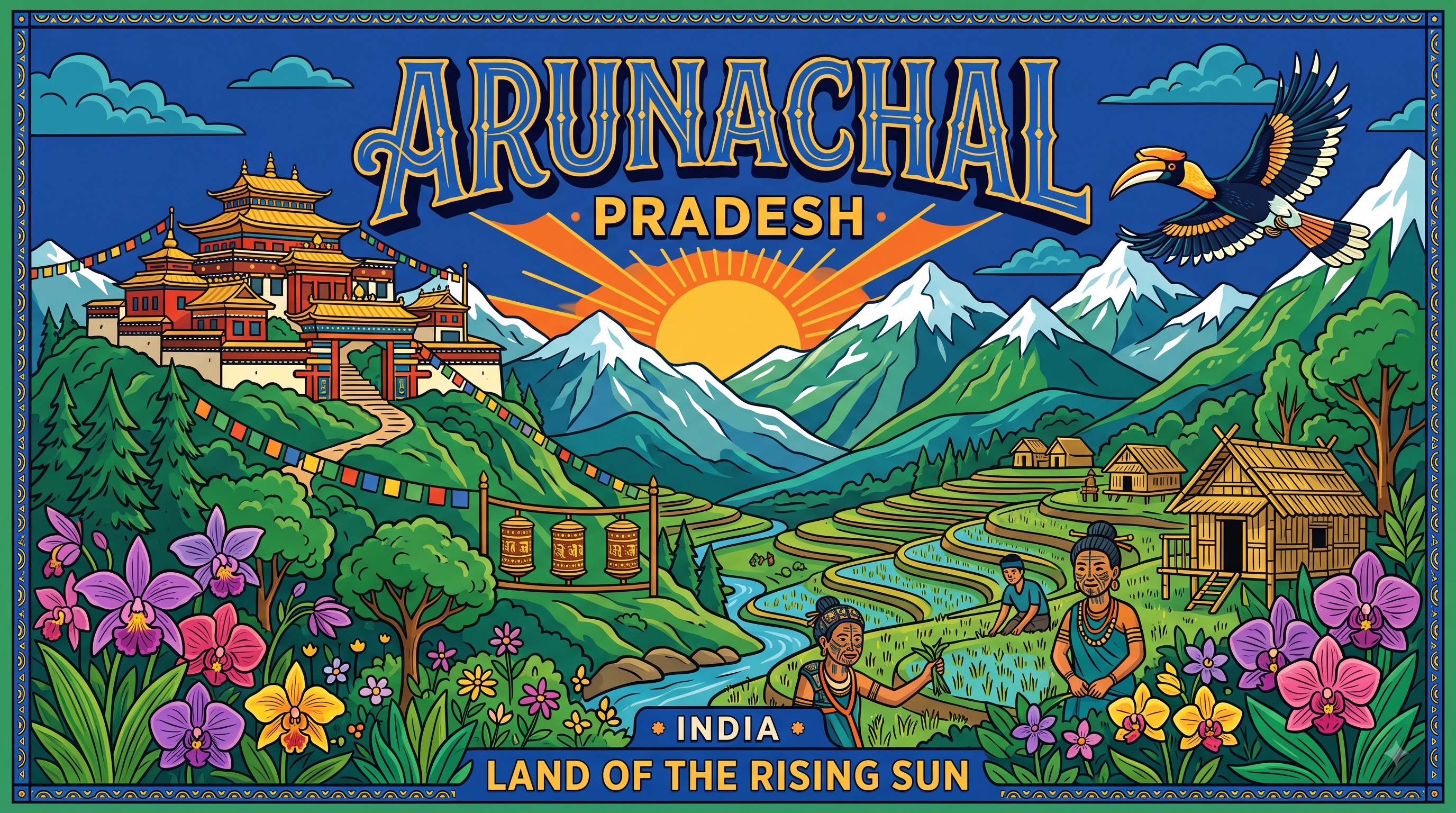
Overview & Heritage
Arunachal Pradesh • Northeast India
Arunachal Pradesh is India's easternmost state, the place where the sun first rises over the country each morning at Dong village in Anjaw. Meaning 'Land of Dawn-Lit Mountains', it sprawls across 83,743 km² of the Eastern Himalayas, larger than any other Northeastern state, yet holds only a projected 1.6 million people (2025 projection), giving it India's lowest population density at about 17 persons per km². Bordered by Bhutan to the west, China (Tibet) to the north and northwest, Myanmar to the east, and Assam and Nagaland to the south, it is both a strategic frontier and an ecological bridge between the Indian subcontinent and Southeast Asia. Itanagar, nestled in the foothills of Papum Pare, is the capital, while Tawang and Bomdila perch in the high Himalayas. Students remember Arunachal for three standout features: it has almost 80% forest cover, the highest in India; it is home to more than 26 major tribes and over 100 sub-tribes speaking some 50 dialects; and it lies within the Eastern Himalaya Biodiversity Hotspot, making it a living laboratory for geography, biology and cultural studies.
“A cornerstone of Northeast India, Arunachal Pradesh embodies millennia of vibrant history, distinct geography, and legendary cultural traditions.”
History & Dynasties
For centuries Arunachal was a mosaic of independent tribal polities rather than a single kingdom, with the Monpa in the west, Apatani in the Ziro valley, Adi, Nyishi, Galo, Mishmi and Tagin shaping distinct village republics, oral chronicles and mountain trade links to Tibet and Burma. Written records note the 7th-century influence of Tibetan Buddhism in Tawang and the later Ahom interactions in the foothills. The iconic Tawang Monastery, founded in 1680–81 by Merak Lama Lodre Gyatso at the behest of the 5th Dalai Lama, became the largest monastery in India and the second largest of the Gelugpa school in the world after Lhasa's Potala Palace, housing more than 300 monks. Under British rule the area was loosely administered as the North-East Frontier Tracts, later renamed the North-East Frontier Agency (NEFA) in 1954 after Independence, governed directly by the Ministry of External Affairs due to its frontier sensitivity. The 1962 Sino-Indian War, with major fighting at Tawang and Walong, brought sharp national attention to the region. NEFA became a Union Territory on 20 January 1972, with Itanagar designated as capital, and after sustained administrative development it attained full statehood on 20 February 1987 as the 24th state of India — a date celebrated as Statehood Day. This progression from NEFA to Union Territory to state in 1987 is a key exam timeline to distinguish from other Northeastern states created in 1972.
Nature & Geography
Arunachal Pradesh is a vertical geography textbook. Elevation plunges from Kangto (7,090 metres) on the Tibet border, the state's highest peak, down to about 100 metres in the foothill valleys, creating tropical rainforest, subtropical pine, temperate conifer, alpine meadow and permanent snow within a single state transect. About 80% remains under forest, including India's northernmost lowland evergreen rainforests in Namdapha. Climate shifts accordingly: humid subtropical in the foothills with over 3,000 mm of rainfall in places, temperate in mid-altitudes, and alpine cold in Tawang and Dibang where winter temperatures fall well below freezing. Major rivers all feed the Brahmaputra: the Siang (called Dihang in Arunachal, Tsangpo in Tibet), which enters at Gelling, joins the Dibang and Lohit at Sadiya to become the Brahmaputra; other key rivers are the Subansiri, Kameng and Noa-Dihing. Namdapha National Park and Tiger Reserve in Changlang district spans 1,985 km² along the Noa-Dihing and is India's third-largest national park — celebrated as the only protected area in the world known to harbour four big cat species: Tiger, Leopard, Clouded Leopard and Snow Leopard, thanks to its 200 to 4,571 metre altitudinal range. Other vital habitats are Pakke Tiger Reserve (rich in hornbills), Eaglenest Wildlife Sanctuary (a birding global hotspot with Bugun liocichla discovered in 2006), Sessa Orchid Sanctuary housing over 200 orchid species, and the Dibang Wildlife Sanctuary. The Eastern Himalaya Biodiversity Hotspot here shelters red pandas, Mishmi takin, hoolock gibbons and blue vanda orchids.
Culture & Arts
Culture in Arunachal is inseparable from tribe and terrain. English is the sole official language, used in schools and administration to connect dozens of Tibeto-Burman languages such as Monpa, Apatani, Nyishi, Adi, Galo, Mishmi and Nocte that are spoken at home — a linguistic diversity rarely matched in India. Religion follows the same pattern: the Monpa of Tawang and West Kameng practice Tibetan Mahayana Buddhism centred on Tawang Monastery, while many central and eastern tribes follow Donyi-Polo, the belief in the Sun (Donyi) and Moon (Polo), alongside Christianity and indigenous shamanic traditions. This creates a vibrant festival calendar. Losar is the Monpa Tibetan New Year at Tawang, Dree is the Apatani agricultural festival in Ziro where priests pray for a bumper harvest, Solung is the Adi harvest festival, and Nyokum is celebrated by the Nyishi. The Apatani of the Ziro valley are studied worldwide for sustainable farming — they practice integrated rice-fish cultivation on flat valley terraces irrigated by bamboo channel networks, conserving water without modern pumps, and are traditionally known for facial tattoos and nose plugs (now fading among younger generations). Craft traditions include Monpa thangka painting and wood carving, Adi bamboo and cane weaving, and Wancho wood sculpture. Cuisine features bamboo shoot, smoked meat and fermented soya — dishes like bamboo shoot pickle, pike pila (bamboo shoot porridge) and marua millet brews show how forest and field shape the kitchen.
Fun Facts
Dong village in Anjaw district, at about 28°N 97°E, sees India's first sunrise; from October to February the sun can appear there as early as 4:45 am IST, well before anywhere else in the country.
Tawang Monastery, perched at about 3,000 metres, is India's largest and the world's second-largest Tibetan Buddhist monastery, home to a 28-foot gilded Buddha statue and a famed old library with rare Buddhist scriptures.
Namdapha National Park (1,985 km², established 1974, declared tiger reserve 1983) is the only national park on Earth documented to host Tiger, Common Leopard, Clouded Leopard and Snow Leopard together due to its extreme altitudinal gradient.
With about 17 persons per km² (2011 Census, projected similar in 2025), Arunachal Pradesh has the lowest population density of any Indian state, less than one-twentieth the national average.
Arunachal is called the 'Orchid State of India', hosting over 600 orchid species — more than 40% of India's orchids — with Arunachal's Sessa Orchid Sanctuary alone sheltering over 200 species including the blue vanda.
The Sela Pass, connecting Tawang to the rest of Arunachal at 13,700 feet (4,170 metres), is one of the world's highest motorable mountain passes and remains snow-covered for much of the year, with the sacred Sela Lake beside the road.