
Rajasthan
“Land of kings, majestic forts, and golden deserts”
Overview & Heritage
Rajasthan • North India
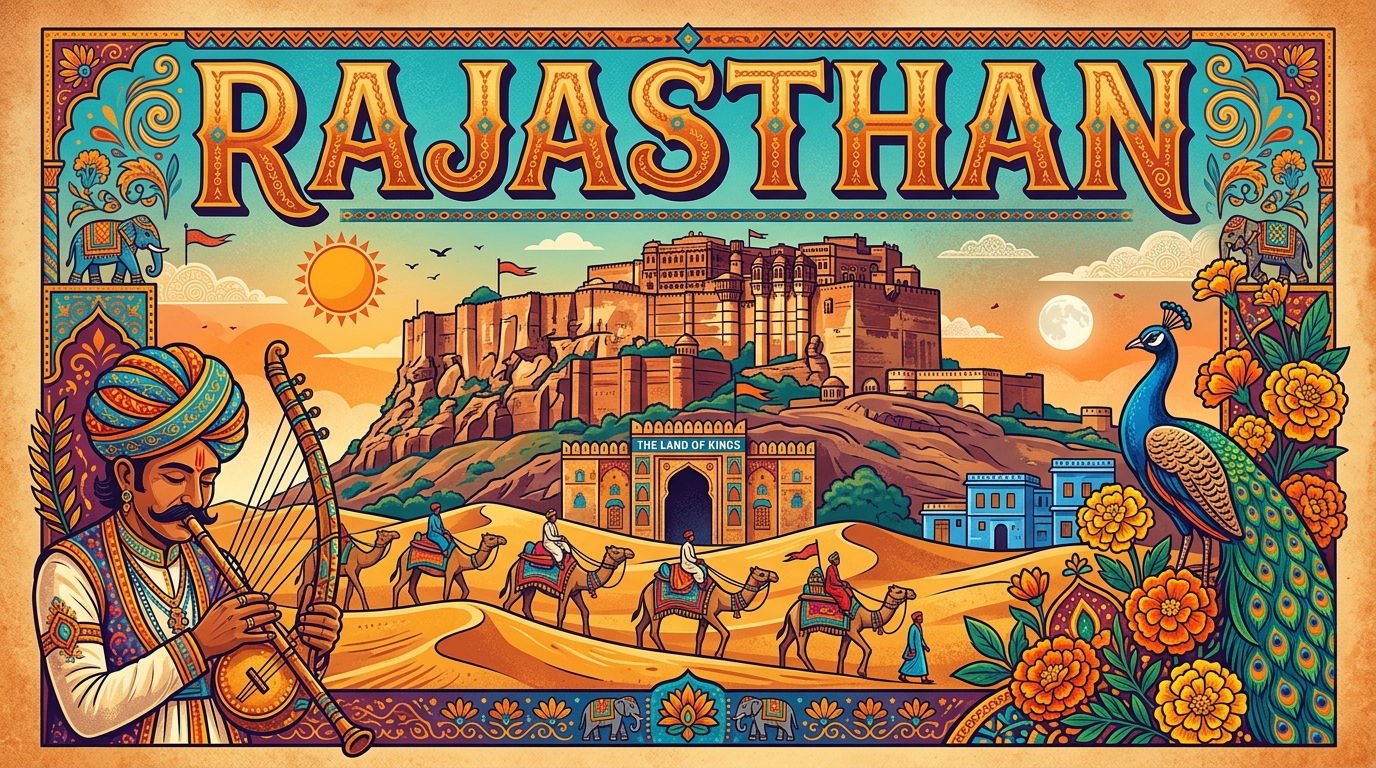
Rajasthan — the 'Land of Kings' — occupies 342,239 km² in northwestern India, making it India's largest state by area, larger than many countries yet home to a projected 81 million people (2025) at a relatively low density. Bordered by Pakistan to the west, Punjab and Haryana to the north, Madhya Pradesh and Gujarat to the southeast and south, and the ancient Aravalli hills running like a spine through its center, Rajasthan is a study in scale. If a student retains just one image, it should be this: honey-coloured hill forts rising above Thar Desert dunes, blue-washed houses of Jodhpur, and the pink grid of Jaipur, all tied together by stories of Rajput valour, desert ecology, and one of the world's oldest mountain ranges. Jaipur, the capital founded in 1727 by Maharaja Sawai Jai Singh II and India's first planned city, anchors a state famed for hospitality, handicrafts, and conservation.
“A cornerstone of North India, Rajasthan embodies millennia of vibrant history, distinct geography, and legendary cultural traditions.”
History & Dynasties
Rajasthan's past is synonymous with the Rajputs, clans that ruled for over a millennium and gave the region its former name Rajputana. Excavations at Kalibangan (a Harappan site on the Ghaggar) show urban life here dating to about 3000 BCE, and later the Matsya and Surasena kingdoms were prominent in Vedic literature. From the 7th century CE, Rajput dynasties — Pratiharas, Chauhans of Ajmer and Delhi, Sisodias of Mewar, Rathores of Marwar, and Kachhwahas of Amber — built great fortresses to defend trade routes and honor codes. Chittorgarh Fort, the largest fort in India at 700 acres, witnessed three major sieges and the ritual of jauhar; Kumbhalgarh, built by Rana Kumbha in the 15th century, encloses 36 km of walls, the second-longest continuous wall after the Great Wall of China.
Muslim conquests brought the Delhi Sultanate and Mughals, who alternately warred with and allied via marriage to Rajput houses — Akbar's wife Mariam-uz-Zamani was the daughter of Raja Bharmal of Amber. Maharana Pratap's resistance at Haldighati (1576) remains iconic. Under the British, Rajputana comprised 22 princely states and two chiefships. After Independence in 1947, these were integrated in seven stages between 1948 and 1956; the present state of Rajasthan was formed on 30 March 1949, celebrated annually as Rajasthan Day, and its boundaries finalized under the States Reorganisation Act. Jaipur was made capital in place of Jodhpur, and Mount Abu's status was settled with Bombay State — a formation timeline students should distinguish from the larger 1956 national reorganization.
Nature & Geography
Rajasthan is sharply divided by the Aravalli Range, one of the world's oldest fold mountains at about 1.5 billion years old according to geological surveys — older than the Himalayas — running diagonally for about 688 km from Delhi to Gujarat with Guru Shikhar on Mount Abu (1,722 meters) as its highest peak inside the state. Northwest of the Aravallis lies the Thar Desert, India's largest arid region, covering about 60% of Rajasthan with sandy plains, dunes that rise to 150 meters, salt pans at Sambhar (India's largest inland salt lake at 190 km²), and scrub forests of khejri and babool adapted to under 200 mm annual rainfall. Southeast of the Aravallis is the fertile, semi-arid Mewar and Hadoti plateau, watered by the Banas, Chambal, and Luni rivers — the Luni being a rare west-flowing river that ends in the Rann of Kutch.
Climate is desert and semi-arid: summer temperatures routinely exceed 46°C, winter nights can drop near freezing in the desert, and rainfall is highly variable. Despite aridity, Rajasthan supports remarkable protected areas. Ranthambore Tiger Reserve near Sawai Madhopur offers one of India's best chances to see Bengal tigers against the backdrop of a 10th-century fort; Sariska Tiger Reserve in Alwar is notable for the country's first tiger reintroduction programme after local extinction in 2004. Keoladeo National Park at Bharatpur — a UNESCO World Heritage man-made wetland — hosts thousands of migratory birds including the Siberian crane (now rare) and the painted stork each winter. Desert National Park near Jaisalmer conserves the endangered Great Indian Bustard and the dunes where fossilized Jurassic forests at Akal have been preserved.
Culture & Arts
Rajasthan's living culture is perhaps India's most visually distinctive. UNESCO has inscribed the Hill Forts of Rajasthan (six forts including Chittorgarh, Kumbhalgarh, Ranthambore, Jaisalmer, Amer, and Gagron) as a serial World Heritage Site; Jaisalmer Fort is famously a 'living fort' where about 3,000 people still reside within its walls. Folk music and dance are globally recognized: Kalbelia dance by the snake-charmer community (now UNESCO Intangible Cultural Heritage), Ghoomar (graceful spinning by women in flowing ghagras), Kathputli string puppetry, and the soulful Manganiyar and Langa musicians of Barmer and Jaisalmer whose ballads preserve genealogies for centuries.
Craft traditions are GI-tagged and economically vital — Bandhani tie-dye, Bagru and Sanganeri block prints, Jaipur blue pottery (imported via Persia during Mughal times), leather juttis from Jodhpur, miniature paintings from Kishangarh, and lac bangles from Jaipur's markets. Language at home is often Rajasthani dialects — Marwari, Mewari, Dhundhari, and Shekhawati — with Hindi as official. Cuisine reflects water scarcity: dal baati churma (hard wheat balls baked on cow-dung cakes, crushed and mixed with ghee, jaggery, and dal), gatte ki sabzi (gram flour dumplings in curd), and ker sangri (desert beans and berries). Festivals of Pushkar Camel Fair, Jaipur Literature Festival, and Desert Festival at Jaisalmer turn the desert into stage and market, drawing visitors for cattle trading, folk contests, and book readings alike.
Fun Facts
Kumbhalgarh Fort's wall stretches 36 km without a break — the second longest continuous wall on Earth after the Great Wall of China — and is wide enough in places for eight horses to ride abreast.
Jaipur is called the 'Pink City' because its plastered buildings were painted terracotta pink in 1876 to welcome the Prince of Wales (later Edward VII); Jodhpur's Brahmin houses around Mehrangarh Fort are painted indigo blue, and Jaisalmer's sandstone glows golden — together they give Rajasthan three colour-coded cities.
The Thar Desert is the world's 17th largest desert and the most densely populated; it supports about 83 people per km² despite receiving as little as 120 mm rain in western Jaisalmer.
The Aravalli Range at about 1.5 billion years old is one of the oldest mountain systems on the planet, far older than the Himalayas which formed only about 50 million years ago — a favourite comparative question in geology exams.
Sambhar Salt Lake, a Ramsar wetland, is India's largest inland saline lake and has supplied salt since before the Mauryan period (4th century BCE); it is a crucial wintering ground for flamingos.
Udaipur's Lake Pichola was created in the 14th century and its island palaces — Lake Palace (now a hotel) and Jag Mandir — famously sheltered Shah Jahan before he built the Taj Mahal, linking Rajasthan directly to the history of the Mughal wonder.