
Punjab
“Land of five rivers and golden fields of wheat”
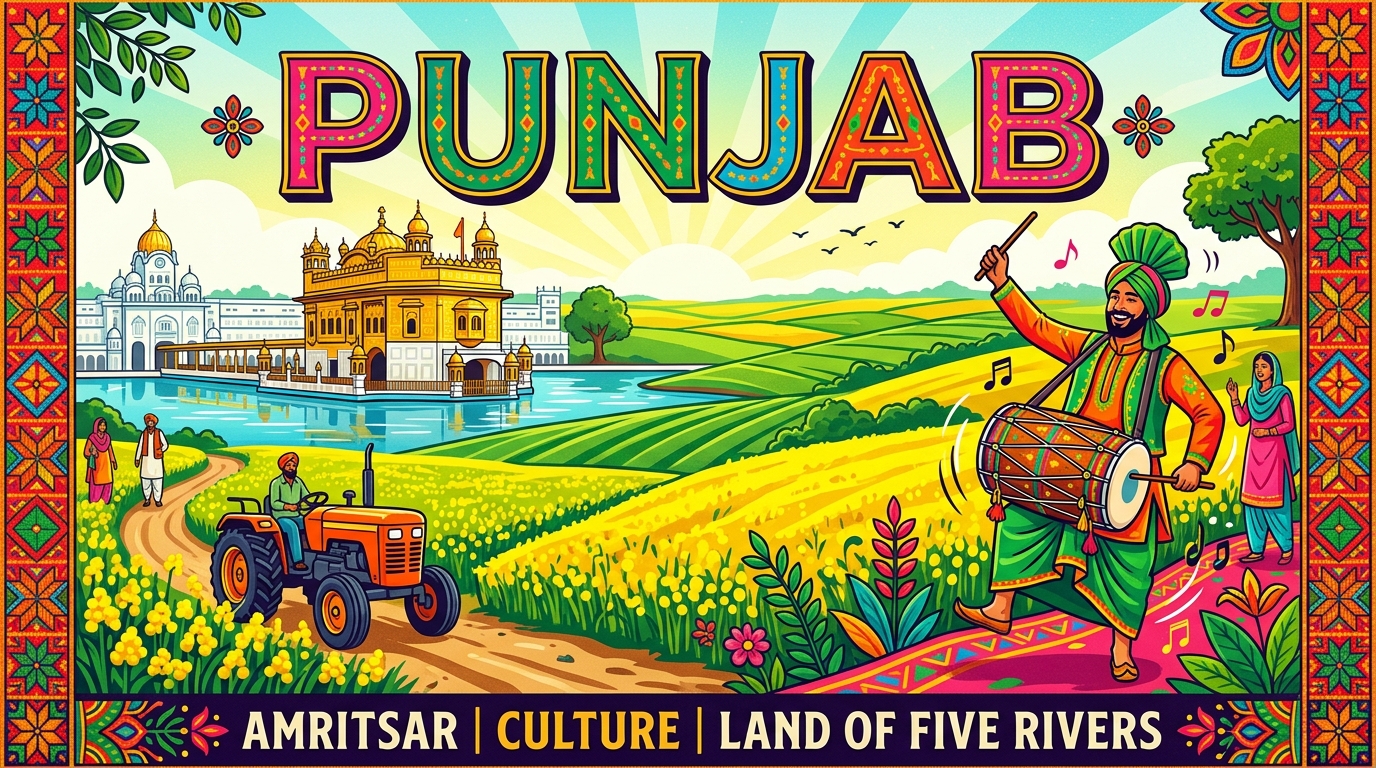
Overview & Heritage
Punjab • North India
Punjab — from the Persian panj (five) and ab (water), 'Land of Five Rivers' — covers 50,362 km² in the northwest, bounded by Pakistan to the west, Jammu and Kashmir to the north, Himachal Pradesh to the northeast, Haryana and Rajasthan to the south. If you keep one sight in memory, it should be this: endless golden wheat fields cut by a glittering canal at sunset, with the domes of the Golden Temple reflecting in its sacred sarovar. Home to a projected 30.5 million people (2025), with Chandigarh as its joint capital with Haryana (a Union Territory designed by Le Corbusier), Punjab is India's 19th-largest state by area but its agricultural heart. Only three of the five historic Punjab rivers — the Sutlej, Beas and Ravi — now flow within modern Indian Punjab; the Jhelum and Chenab lie mostly across the border. Yet with just 1.53% of India's land, the state contributed for decades over 40% of India's wheat and nearly 30% of rice to the central pool during the Green Revolution. It is the birthplace of Sikhism, founded by Guru Nanak Dev in the 15th century, and the centre of the warm, resilient culture captured in the concept of chardi kala (eternal optimism).
“A cornerstone of North India, Punjab embodies millennia of vibrant history, distinct geography, and legendary cultural traditions.”
History & Dynasties
Punjab has been a gateway to the subcontinent. The Harappan site of Ropar shows urban life here from around 2600 BCE, followed by Vedic settlements along the Saraswati and Sutlej. Ancient empires — Gandhara, Mauryan, Gupta, Shahi — contested the region, and in 326 BCE Alexander fought at Hydaspes (Jhelum) against King Porus. The medieval period saw Ghaznavid, Sultanate and Mughal rule, with Lahore and Sirhind as great centres, before Sikhism emerged. Guru Nanak (1469-1539), born at Nankana Sahib (now in Pakistan), and nine succeeding Sikh Gurus created a distinct faith synthesising bhakti and social equality; Guru Arjan compiled the Adi Granth and built the Harmandir Sahib at Amritsar (completed 1604), and Guru Gobind Singh institutionalised the Khalsa in 1699 at Anandpur Sahib. After Mughal decline, Maharaja Ranjit Singh unified Punjab from Lahore between 1799 and 1839, creating a secular, modernising Sikh Empire with European-officered armies that stretched from the Khyber to the Sutlej. Annexed by the British after the Second Anglo-Sikh War in 1849, Punjab became a major recruitment base and canal colony. Partition in 1947 split the five rivers: western Punjab became Pakistan, provoking a massive population exchange that reshaped Indian Punjab. Patiala and East Punjab States Union (PEPSU) merged with Punjab in 1956, and after the Punjabi Suba movement for a Punjabi-speaking state, Indian Punjab was reorganised on linguistic lines on 1 November 1966 under the Punjab Reorganisation Act — creating Hindi-majority Haryana, transferring hill areas to Himachal Pradesh, and leaving contemporary Punjabi-speaking Punjab with Chandigarh as shared capital.
Nature & Geography
Punjab is overwhelmingly a fertile alluvial plain, part of the Indo-Gangetic system, with an average elevation near 300 metres — from 180 metres in southwestern Fazilka, where it merges into the Thar fringes, to over 500 metres at the Shivalik foothills in the northeast. Despite the name, the hydrology today is three-river: the Sutlej (Punjab's longest), Beas and Ravi flow west-southwest, heavily barraged (Bhakra-Nangal on the Sutlej, Pong on the Beas, Ranjit Sagar on the Ravi) and interlinked by the Indira Gandhi Canal and the Sirhind Canal system that made the Green Revolution possible. Soils are deep loams and sandy loams, heavily cultivated; natural forest cover is among India's lowest (under 5%), with only remnants of dry deciduous and Shivalik scrub near Ropar and Hoshiarpur. Climate is continental semi-arid: summer heat above 45°C, monsoon July to September with 400 to 800 mm rainfall sharply decreasing south-westward, and cold foggy winters where temperatures can fall near 2°C. Protected areas are small but important: Harike Wetland at the confluence of Sutlej and Beas (a Ramsar site since 1990) shelters the endangered Indus river dolphin (bhulan) and wintering greylag geese; Abohar Wildlife Sanctuary is India's largest blackbuck sanctuary managed by the Bishnoi community; Nangal Wildlife Sanctuary protects Shivalik forest; and the Beas Conservation Reserve now protects the Indus dolphin population. The southwest around Ferozepur and Bathinda is semi-arid with kikar (acacia) and thorny scrub.
Culture & Arts
Punjab's culture is inseparable from Sikhism and agrarian life. The Golden Temple (Sri Harmandir Sahib) at Amritsar, clad in 750 kg of gold and set in the Amrit Sarovar, is the most sacred shrine of Sikhism. Built with four entrances to welcome all castes and faiths and with the foundation reportedly laid by the Muslim saint Mian Mir, its langar (community kitchen) feeds well over 100,000 people daily in one of the world's largest free kitchens — volunteers peel, cook and wash dishes in continuous sewa. Twelve of the other major Sikh shrines, including Anandpur Sahib, Fatehgarh Sahib and Damdama Sahib, lie in Punjab. Languages and folk arts reinforce identity: Punjabi in Gurmukhi script is the sole official language, sole living Indo-European language that is fully tonal and the tenth most spoken worldwide, spoken by about 90% of residents (2011 Census). Bhangra — originally a men's harvest dance for Vaisakhi, now global — and its counterpart Giddha (women's clap-dance), are performed to the beat of the dhol, while Phulkari (flower-work) embroidery in silk threads on cotton, now a GI tag, decorates dupattas. Cuisine is hearty and tandoor-centred: makki di roti with sarson da saag in winter, butter chicken, amritsari kulcha, chole bhature, and lassi. Festivals of Vaisakhi (harvest and Khalsa founding), Lohri bonfires in January, Gurpurabs marking the Gurus' births, and the Hola Mohalla martial display at Anandpur define the calendar. Even the daily lowering of flags at the Wagah-Attari border, 30 km from Amritsar, has become a theatrical ritual of high-kicks and roars watched by thousands.
Fun Facts
The Golden Temple's langar serves more than 100,000 meals daily, and on festivals up to 200,000, using volunteer labour and donations, with a community kitchen that never closes.
Punjab contributed over 40% of India's wheat and about 25-30% of its rice to the buffer stock at the peak of the Green Revolution, earning the durable title 'Granary of India' despite having only 1.53% of the nation's area.
The Wagah-Attari border ceremony 30 km from Amritsar features a daily high-stepping drill by Border Security Force and Pakistan Rangers that has run since 1959 and draws more than 10,000 spectators on weekends.
Phulkari, the silk-on-cotton embroidery where every stitch is done from the reverse to form geometric flower motifs, received a Geographical Indication tag for Punjab in 2010.
Chandigarh, designed by Swiss-French architect Le Corbusier and planned from 1952, was India's first planned city after Independence; its Capitol Complex is a UNESCO World Heritage Site for modern architecture.
Three of the five Punjab rivers — Sutlej (1,450 km total), Beas (470 km) and Ravi (720 km) — flow through Indian Punjab today, while the Jhelum and Chenab flow largely through Pakistan.