
Maharashtra
“Economic powerhouse and land of Maratha forts”
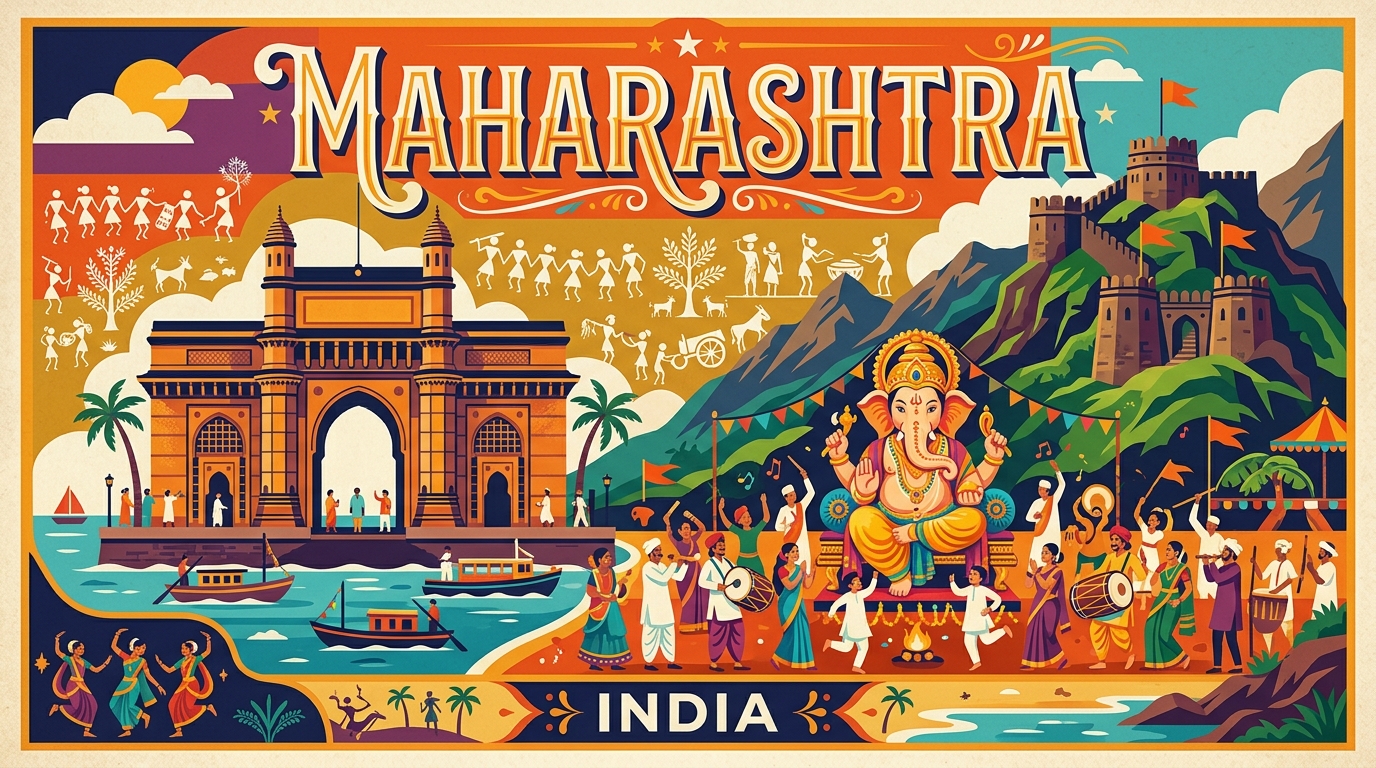
Overview & Heritage
Maharashtra • West India
Maharashtra stretches from the Arabian Sea coast to the heart of the Deccan Plateau in western India, covering 307,713 km² — India's third largest state — and carrying a projected 127.5 million people (2025), second only to Uttar Pradesh. Its capital Mumbai is India's financial capital, home to the Bombay Stock Exchange, Bollywood, and the busiest port, while Nagpur serves as the winter capital. If a student remembers one snapshot, it is this: Maharashtra is India's economic engine that contributes roughly 14–15% of GDP, and its history — rock-cut caves at Ajanta and Ellora, sea forts of the Marathas, and the Gateway of India — reads like an anthology of Indian civilization. The Sahyadri mountains, fertile river valleys of the Godavari and Krishna, bustling sugarcane belts, and the Konkan coastline all coexist within one state, giving it the most diverse geography and economy of any Indian state.
“A cornerstone of West India, Maharashtra embodies millennia of vibrant history, distinct geography, and legendary cultural traditions.”
History & Dynasties
Maharashtra's recorded past begins with Chalcolithic Jorwe culture sites (c. 1300–700 BCE) and Mauryan rule in the 4th–3rd centuries BCE. The Satavahana dynasty (c. 230 BCE–220 CE), with capital at Paithan and later Junnar near Pune, made the region a wealthy trade hub; they excavated early Buddhist caves at Karla, Bhaja, and Ajanta. Successive powers — Vakatakas, Chalukyas, Rashtrakutas, and Yadavas of Devagiri (Daulatabad) — left behind Ellora's extraordinary Kailasa Temple (Cave 16), the world's largest monolithic rock excavation carved top-down from a single basalt cliff in the 8th century under Rashtrakuta king Krishna I.
The medieval period brought the Bahmani Sultanate, the Ahmadnagar and Bijapur Sultanates, and Mughal incursions. Then, in the 17th century, Chhatrapati Shivaji Maharaj (1630–1680) founded the Maratha Empire from his hill forts, using guerrilla warfare, a navy on the Konkan coast, and the forts of Raigad (his capital), Sinhagad, Pratapgad, and the sea fort of Sindhudurg to challenge the Mughals. The empire expanded under the Peshwas to dominate western and central India until the Third Battle of Panipat (1761) and eventual defeat by the British in 1818. Mumbai, taken by the Portuguese and gifted to the English in 1661, grew as a colonial port. After Independence, the Samyukta Maharashtra movement demanded a Marathi-speaking state; after protests in which 105 people died, the Bombay Reorganisation Act created Maharashtra and Gujarat as separate states on 1 May 1960 — celebrated annually as Maharashtra Day. Students should note this bifurcation date, a frequent exam question.
Nature & Geography
Maharashtra's spine is the Western Ghats, locally called the Sahyadris, running 700 km parallel to the coast. Their average elevation of about 1,200 meters, with Kalsubai at 1,646 meters as the highest peak, creates three clear zones. To the west is the Konkan — narrow coastal plains 50–80 km wide with estuaries, mangroves, and high rainfall (up to 200 cm) that feed paddy and mango orchards (Alphonso from Ratnagiri). Atop the Ghats lie cool hill stations — Mahabaleshwar, Lonavala, Matheran — and to the east the vast, basaltic Deccan Plateau formed by ancient volcanic flows, semi-arid with black cotton soils ideal for cotton, soybean, and oranges (Nagpur's famous crop). The Satpura Hills border the north, and the Bhamragad-Chiroli ranges define the east.
Major rivers are the Godavari (India's second longest at 1,465 km, rising at Trimbakeshwar near Nashik and flowing east across the state), Krishna, Bhima, Tapi-Purna, and Wardha-Wainganga. Because central Maharashtra is rain-shadowed, the state relies heavily on dams — it has over 1,800 large dams, the most in India — with Koyna and Jayakwadi among the largest. Lonar Lake in Buldhana district is a scientific curiosity: a hyper-velocity meteorite created a 1.8 km crater lake about 50,000 years ago, the only one of its kind in basalt. Protected areas include Tadoba-Andhari Tiger Reserve, Melghat Tiger Reserve for tigers and sloth bears, and the UNESCO-listed Western Ghats forests that shelter lion-tailed macaques, Malabar pied hornbills, and endemic amphibians.
Culture & Arts
Maharashtra is a cultural crossroads where classical, folk, and industrial India meet. Ajanta (2nd century BCE–5th century CE, famed for Buddhist mural paintings) and Ellora (mixed Buddhist, Hindu, and Jain caves spanning 600–1000 CE) are UNESCO World Heritage Sites and textbook examples of rock-cut architecture, studied alongside Elephanta Caves off Mumbai harbour. Pune is considered the state's cultural capital, famed for Marathi theatre, the Sawai Gandharva music festival, and literary heritage.
Festival life is dominated by Ganesh Chaturthi, celebrated as a public festival since freedom fighter Bal Gangadhar Tilak popularized it in the 1890s to unite people; Mumbai's Lalbaugcha Raja draws millions. Folk arts include Lavani (energetic song-dance performed to the beat of the dholki), Tamasha folk theatre, Powada ballads recounting Shivaji's deeds, Warli tribal painting from the Sahyadris (white geometric figures on mud walls), and wooden Channapatna toys. Cuisine ranges from the coastal Konkani thali with fish curry and sol kadhi, to Pune's misal pav and mastani, to Kolhapuri mutton famous for its chilli. Crafts like Paithani sarees with peacock motifs, Kolhapuri leather chappals, and Bidri metalwork are GI-tagged. Hindi-Marathi cinema, centered in Mumbai's Film City, makes Maharashtra the home of Bollywood — the world's largest film industry by number of films — whose studios shape how India is seen worldwide.
Fun Facts
Ellora's Kailasa Temple (Cave 16) is the world's largest single monolithic rock excavation — architects carved an estimated 400,000 tonnes of rock top-down to create a full temple complex with shrine, courtyard, and gopuram from one cliff.
Chhatrapati Shivaji Maharaj built or restored over 300 forts; Sindhudurg sea fort off Malvan was built on a rocky islet in 1664 and its foundation stones were laid with lead — an early engineering innovation in the Arabian Sea surf.
Mumbai's Chhatrapati Shivaji Maharaj Terminus (CSMT), formerly Victoria Terminus, is a UNESCO World Heritage Victorian Gothic railway station opened in 1887 for Queen Victoria's Golden Jubilee and still handles over 3 million commuters daily.
The Lonar Crater Lake in Buldhana was formed by a hyper-velocity meteorite impact about 50,000 years ago and is the only confirmed hyper-velocity impact crater in basaltic rock anywhere on Earth — studied by NASA and the Geological Survey of India.
Nashik in Maharashtra is known as India's Wine Capital, producing over 80% of the country's wine around Sula and Grover vineyards along the Godavari valley.
As per government economic data, Maharashtra consistently contributes about 14–15% of India's GDP and roughly 15% of its industrial output, making it the only Indian state with a trillion-dollar economy (measured in purchasing power terms in recent projections).