Tamil Nadu
“Land of Dravidian temples and classical arts”
Overview & Heritage
Tamil Nadu • South India
Tamil Nadu anchors the southeastern corner of India, washed by the Bay of Bengal to the east and the hills of the Western Ghats to the west, with a maritime boundary toward Sri Lanka. Encompassing 130,058 km² and a projected 76.8 million people (2025), it is India's tenth largest state by area and a national leader in manufacturing, healthcare, and higher education. If a student retains one snapshot, it should be this: Tamil Nadu is the custodian of an unbroken classical tradition — where Tamil, declared India's first classical language and one of the world's oldest living languages, meets soaring Dravidian temple towers. From Chennai's Marina Beach, the world's second longest urban beach at 13 km, to the Nilgiri hills, the Cauvery delta, and the factory floors of Coimbatore and Hosur, the state blends deep antiquity with modern industry. Its capital Chennai is both a 400-year-old port city and the Detroit of South Asia for automobile production.
“A cornerstone of South India, Tamil Nadu embodies millennia of vibrant history, distinct geography, and legendary cultural traditions.”
History & Dynasties
Human habitation in Tamil Nadu is among the oldest in South India, with evidence from the stone tools at Attirampakkam dating back over 300,000 years according to archaeological surveys, and later Sangam-period literature (c. 300 BCE–300 CE) that chronicles the three great Tamil dynasties — the Cholas, Cheras, and Pandyas, collectively the Muvendhar or Three Crowned Kings. The Pandyas ruled southern Tamil Nadu from Madurai, famed for pearl fisheries at Korkai and patronage of Sangam poetry. The early Cholas governed the fertile Cauvery delta from Uraiyur and the port of Puhar, legendary for maritime trade with Rome.
The Pallavas (4th–9th century CE) at Kanchipuram pioneered Dravidian rock-cut architecture visible at Mahabalipuram's Shore Temple and Pancha Rathas, both UNESCO sites. Then came the Imperial Cholas under Rajaraja I (985–1014 CE) and his son Rajendra Chola I (1014–1044 CE), who built the Brihadisvara Temple at Thanjavur (UNESCO, completed 1010 CE with a 66-meter vimana and an 80-ton capstone) and projected naval power to Sri Lanka, the Maldives, and Srivijaya in Southeast Asia — a rare Indian maritime empire. After Chola decline, the Vijayanagara Empire and its Nayak successors (in Madurai and Thanjavur) shaped early modern art and temple renewal. European trading posts led to British Madras Presidency rule; after Independence, the States Reorganisation Act of 1956 unified Tamil-speaking areas into Madras State, renamed Tamil Nadu ('Tamil Country') in 1969 — a linguistic identity students often encounter in civics discussions of language politics.
Nature & Geography
Tamil Nadu's geography is a staircase from sea to plateau. The east is the wide Coromandel coastal plain, averaging 100–120 km in width, formed by the deltas of the Cauvery (about 800 km total, flowing across the state as its longest river), Palar, Vaigai, and Thamirabarani (one of the few perennial rivers, rising in the Agastyamala hills). Doddabetta in the Nilgiris at 2,637 meters is the highest peak in the state and the second highest in the Western Ghats portion south of the Himalayas. Westward, the Western Ghats rise abruptly to the Nilgiri, Anaimalai, and Palni hills — a UNESCO World Heritage biodiversity hotspot with high rainfall over 2,500 mm — while the Eastern Ghats cross the northeast as discontinuous, lower hills.
Climate is tropical savanna inland and tropical monsoon on the coast, with a crucial twist: Tamil Nadu receives most of its rain from the northeast monsoon between October and December, unlike most of India which depends on the southwest monsoon. This makes its coastal districts among the wettest in winter. Wildlife thrives in the Ghats. Mudumalai and Sathyamangalam Tiger Reserves (linked to Bandipur in Karnataka and Wayanad in Kerala) form a contiguous Nilgiri Biosphere Reserve protecting elephants, tigers, and the endangered Nilgiri tahr. Gulf of Mannar Marine National Park, with 21 islands, is India's first marine biosphere reserve for dugongs, sea turtles, and coral reefs. Point Calimere and Pulicat Lake wetlands are vital for flamingos and migratory birds, while the Palani hills guard the moist shola-grassland mosaic taught in ecology chapters.
Culture & Arts
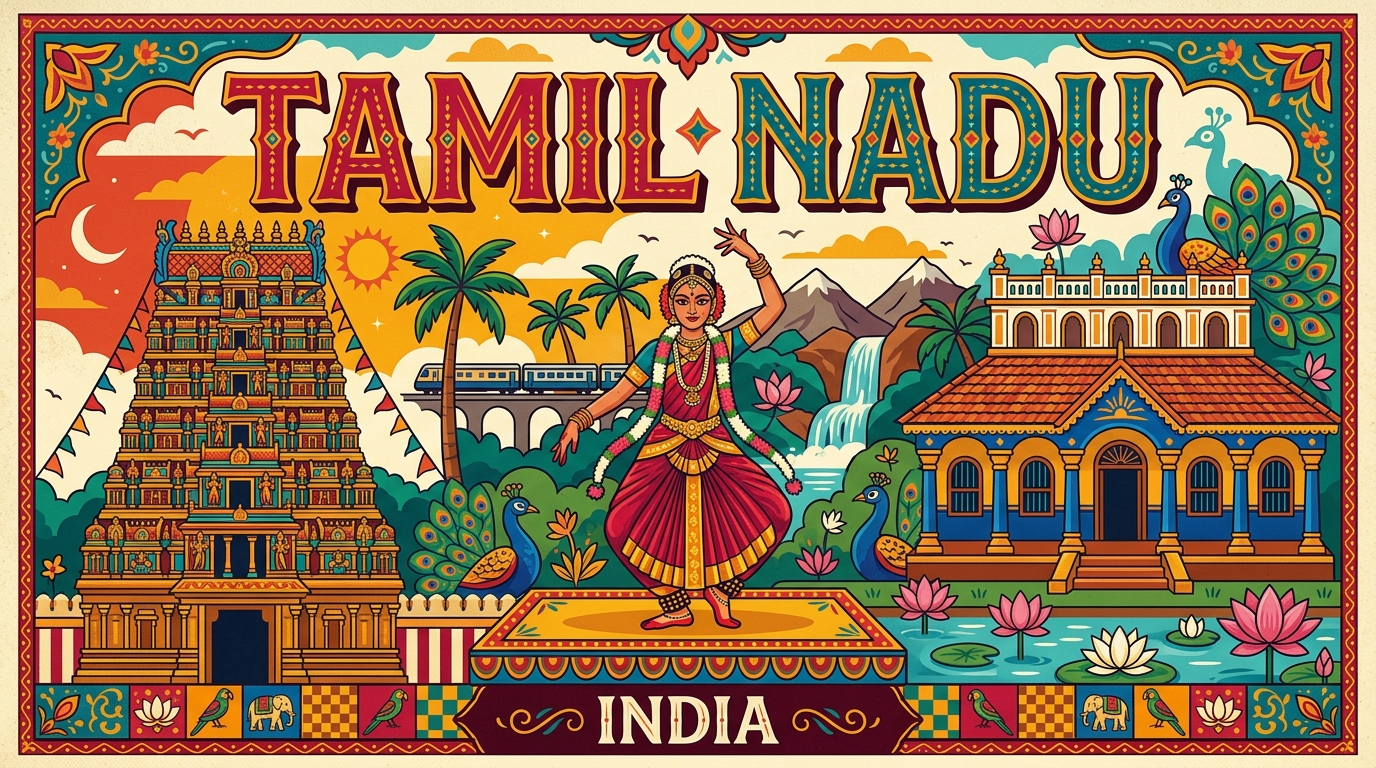
Tamil Nadu's culture is classical, devotional, and technically precise. Tamil itself, with inscriptions dating to the 3rd century BCE and Sangam anthologies that predate much of India's other literature, is central to identity. Bharatanatyam — the state dance originally performed by devadasis in temples as Sadir — was codified by the Thanjavur Quartet in the 19th century and is now one of India's eight classical dances. Carnatic music, with the trinity of Thyagaraja, Muthuswami Dikshitar, and Syama Sastri (all linked to Tiruvarur), fills concert halls each December during Chennai's Margazhi music season, the world's largest classical music festival.
Temple architecture is the state's visual signature. The Great Living Chola Temples (Brihadisvara at Thanjavur, at Gangaikonda Cholapuram, and Airavatesvara at Darasuram) are UNESCO sites showcasing Dravidian vimanas, massive gopurams, and bronze sculpture — the 11th-century Nataraja bronzes of dancing Shiva are globally recognized. Meenakshi Temple at Madurai, Rameswaram's long columned corridors, and Srirangam (the largest functioning Hindu temple complex in India on an island in the Cauvery) are living pilgrimage centers. Cuisine is rice-centered: dosa, idli, sambar, rasam, and the banana-leaf Virudhunagar-style meals; the sliver of Chettinad cuisine from Karaikudi is famous for 20-plus spices. Festivals include Pongal (the four-day harvest thanksgiving in January where the first rice is cooked with milk until it boils over), Jallikattu bull-taming events, and the Chithirai festival at Madurai — all demonstrating how agriculture, faith, and community remain intertwined.
Fun Facts
Tamil Nadu is home to three UNESCO World Heritage categories: the Great Living Chola Temples (cultural), Mahabalipuram's Group of Monuments (cultural), and the Western Ghats (natural) which the state shares with Kerala, Karnataka, and Maharashtra.
Marina Beach in Chennai stretches for about 13 km, making it the longest urban beach in India and the second longest in the world after Cox's Bazar (contested by some geographers, flag: ranking depends on definition of 'urban').
Tamil is one of the world's longest-surviving classical languages, with its earliest inscriptions dated to the 3rd century BCE and its Sangam literature (c. 300 BCE–300 CE) studied worldwide for its secular poetry on love and war.
The Brihadisvara Temple at Thanjavur was built with no mortar, using interlocking granite blocks, and its 80-ton capstone was reportedly hauled up a 6-km earthen ramp — an engineering debate that persists among historians (flag: exact construction method uncertain).
Chennai is called the 'Detroit of South Asia' because it produces over 35% of India's automobile output and hosts factories for every major carmaker; nearby Kanchipuram has woven silk sarees since the Pallava period, with each saree traditionally taking up to three days to weave on a handloom.
Jallikattu, the traditional bull-taming event held during Pongal, was recognized by the Supreme Court in 2023 as part of Tamil Nadu's cultural heritage after years of debate over animal welfare — illustrating how law, culture, and conservation intersect in classroom discussions.